 EnglishEnglish


Views: 0 Author: Site Editor Publish Time: 2026-10-16 Origin: Site


Unplanned downtime in a bio-decontamination cycle halts production immediately. Failed biological indicators (BIs) pose an equally severe threat to regulatory compliance. These disruptions often stem from neglected equipment rather than flawed procedural designs. Effective VHP generator maintenance shifts your operations from reactive troubleshooting to predictive assurance. It focuses strictly on precise equipment calibration, fluidic integrity, and verifiable data trails. Ignoring these components puts high-value batches at risk of quarantine or total loss. To meet stringent GMP Annex 1 and FDA expectations, facility managers must implement a structured, verifiable preventive maintenance (PM) protocol. You will learn how to build this exact framework in the following sections. We will explore critical procedures for auditing vapor delivery systems. You will also discover actionable steps to protect measurement accuracy and secure permanent audit trails for simplified compliance.
Sensor drift is inevitable: Routine VHP sensor calibration prevents false saturation readings and ensures cycle efficacy.
Peroxide degrades hardware: Proactive replacement of vapor delivery components (pumps, tubing, nozzles) is required to maintain consistent injection rates.
Data integrity is non-negotiable: Robust VHP cycle data logging secures 21 CFR Part 11 compliance and simplifies audit defense.
PM scheduling requires risk assessment: Maintenance frequency must align with cycle volume, operating environment, and biological safety levels (e.g., BSL-3/CL-3).
A successful PM program delivers measurable operational stability. It completely eliminates unexpected aborted cycles. It prevents false-positive BI failures. Most importantly, it ensures a highly reproducible 6-log reduction across every validated cycle. You achieve this predictability through strict adherence to scheduled maintenance intervals. Operators can confidently initiate cycles knowing the equipment functions within precise tolerances. Predictive maintenance creates a stable baseline for all subsequent sterility assurance activities.
The cost of failure extends far beyond the price of a replacement part. When a generator faults mid-cycle, facilities face immediate financial and operational impacts. High-value pharmaceutical batches often enter mandatory quarantine periods. Quality assurance teams must execute intensive re-validation labor to prove environment sterility. These compliance deviations generate stressful audit findings and tedious root-cause analysis investigations. Every hour spent recovering from a generator failure is an hour lost in manufacturing throughput. Reactive repairs drain facility resources and damage production schedules irreparably.
Regulatory agencies view proactive maintenance as a strict compliance baseline. It is never just a polite hardware recommendation from the manufacturer. Regulators require strict adherence to cGMP, ISO standards, and biosafety guidelines. Auditors routinely ask for documented proof of equipment upkeep. They want to see that you actively control the variables affecting decontamination efficacy. Framing your maintenance program as a regulatory necessity ensures it receives the appropriate funding and priority. A well-maintained generator acts as a primary defense mechanism during stringent regulatory inspections.
Sensor drift represents an unavoidable physical reality in decontamination equipment. Environmental factors relentlessly degrade both electrochemical and near-infrared sensors over time. Constant chemical exposure to oxidative vapor accelerates this loss of accuracy. A drifting sensor might report a concentration of 400 ppm when the actual room concentration is only 250 ppm. This false saturation reading causes the generator to under-dose the area. The resulting cycle will likely fail to achieve total biological kill. You must acknowledge drift as a continuous threat to measurement accuracy.
Proper calibration relies on established, repeatable methodologies. Technicians primarily use traceable gas standard verifications to establish a known baseline. The process involves two distinct phases. First, technicians perform a zero-point calibration in a completely clean, peroxide-free environment. Next, they execute a span calibration using a certified concentration gas. This verifies the sensor responds accurately at the upper limits of your cycle parameters. Both steps are crucial for maintaining linear accuracy across the entire detection range.
You must establish a rigorous, risk-based frequency for VHP sensor calibration. Do not rely solely on the calendar. Weigh OEM guidelines against your facility's specific usage rates. A generator running daily cycles requires more frequent calibration than a backup unit used monthly. High-demand environments often implement quarterly span checks to catch drift early. Proactive facilities adjust their calibration schedules dynamically based on historical drift data.
Implementation risk poses a significant threat during the calibration process itself. Technicians must document the "as-found" and "as-left" states of every sensor. Failing to record the "as-found" state invalidates all historical cycle data since the last calibration. If a sensor reads 15% out of tolerance upon discovery, you must evaluate the impact on recently released batches. Documenting these states proves you maintain control over your measurement instruments. It provides a transparent audit trail for regulatory reviewers.
Vaporized hydrogen peroxide acts as a highly oxidative agent. It attacks materials aggressively upon contact. Long-term exposure inevitably degrades elastomers, seals, and specialized plastics within the generator. This material compatibility reality dictates your maintenance approach. You cannot wait for a hose to burst. You must audit fluidic pathways proactively. Regular visual and mechanical inspections prevent sudden delivery failures mid-cycle. Understanding this chemical stress helps you anticipate component lifespans accurately.
A comprehensive audit requires focused attention on specific inspection zones. You should divide your delivery system checks into distinct functional categories.
Peristaltic Pumps & Tubing: Inspect these continuous-motion parts for micro-cracks. Check for any flow-rate deviations. Tubing loses elasticity due to constant mechanical rolling and chemical exposure. This flattening reduces the inner diameter and restricts fluid volume.
Injection Nozzles & Evaporators: Look closely for scale buildup or residue on the nozzles. Verify the thermal block operates at peak heating efficiency. Ensure the system produces a uniform vapor dispersion rather than spitting liquid droplets.
Filters (Desiccant & HEPA): Monitor the differential pressure across all filtration units. This practice ensures optimal airflow throughout the generator. It also maintains strict humidity control, which is vital for preventing premature vapor condensation.
Establish strict evaluation criteria for replacing these critical components. Always upgrade to OEM-certified, chemically resistant consumables. Third-party alternatives might seem cost-effective initially. However, they often fail prematurely under oxidative stress. They compromise cycle consistency and risk introducing particulate contamination into your cleanroom. Using certified parts guarantees the generator operates exactly as it did during initial validation. Stick to proven materials to maintain a compliant baseline.
Regulatory alignment demands flawless documentation of every decontamination event. Secure VHP cycle data logging is critical for achieving this alignment. It secures strict compliance with 21 CFR Part 11 and EU Annex 11 guidelines. Regulators no longer accept simple paper printouts as primary evidence. They expect robust, digital-first data ecosystems. Your logging system must protect data from unauthorized alteration, deletion, or manipulation. Digital integrity proves that your physical sterilization process actually occurred as validated.
Your record management strategy must focus on capturing highly specific metadata. The system needs to log critical parameters continuously throughout the cycle. You must capture injection rates, target temperatures, relative humidity, concentration levels (ppm), and exact phase durations. Secure storage is just as important as the capture process. Ensure you use encrypted local drives for immediate backup. For higher security, integrate the generator seamlessly into your facility's LIMS or SCADA architecture. This creates a centralized, unalterable repository for all batch records.
Data integrity requires evidence-oriented action from quality teams. Do not just collect data; review it actively. Regularly verify that audit trails accurately reflect distinct user logins. Ensure operators use unique credentials rather than shared passwords. Document the exact reasons for any aborted cycles immediately. Investigate and log any manual parameter overrides performed by supervisors. Active review of these logs transforms raw data into defensible compliance evidence during a regulatory inspection.
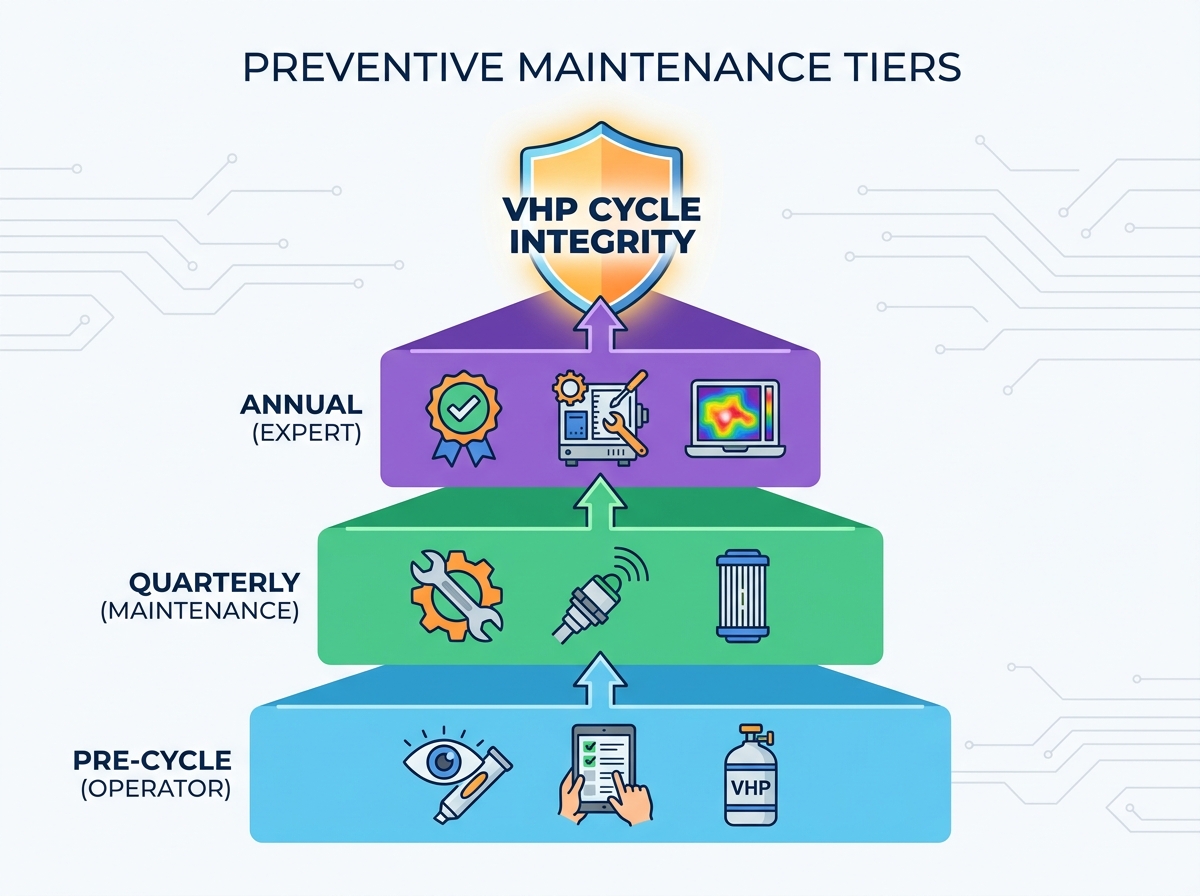
Effective maintenance relies on a tiered, predictable execution schedule. You must assign specific tasks based on technical complexity and operator training levels. This prevents critical checks from falling through the cracks. A tiered approach distributes the workload logically across your organization.
Pre-Cycle (Operator Level): Operators must perform visual inspections of fluid tubing before pressing start. They execute basic leak checks on external connections. They also verify supply bottle weights to ensure sufficient chemical volume exists for the entire cycle.
Quarterly (Maintenance Level): Facility technicians conduct deeper preventative checks. They replace pre-filters and check desiccant status. They perform sensor span verifications using calibration gases. They also measure internal airflow rates to ensure the blower operates within specification.
Annual (Expert Level): Certified specialists perform comprehensive system overhauls. They execute full zero and span calibrations on all sensors. They map thermal outputs on the evaporator block. They replace all internal peristaltic tubing and inspect logic boards for wear.
Adoption risks run high when facilities rely on generic maintenance software. Relying on generic CMMS templates instead of OEM-specific protocols leads to disaster. Standard templates often miss critical failure points unique to peroxide vaporizers. They might schedule a pump inspection but ignore the thermal block entirely. You must customize your maintenance database to reflect the exact requirements outlined in the generator's technical manual.
| Maintenance Task | Frequency | Personnel Level | Primary Objective |
|---|---|---|---|
| Visual Tubing Inspection | Pre-Cycle | Operator | Detect immediate fluid leaks or pinholes. |
| Chemical Weight Verification | Pre-Cycle | Operator | Ensure sufficient peroxide for the validated cycle. |
| Sensor Span Check | Quarterly | Technician | Identify early sensor drift and measurement errors. |
| Airflow & Filter Verification | Quarterly | Technician | Maintain optimal humidity and vapor distribution. |
| Complete System Calibration | Annually | OEM Specialist | Restore exact factory specifications and compliance. |
| Thermal Evaporator Overhaul | Annually | OEM Specialist | Prevent scale buildup and ensure flash vaporization. |
Deciding who performs the annual PM requires logical shortlisting. You must weigh internal capabilities against the stringent demands of regulatory compliance. Shortlisting logic begins by assessing your internal maintenance team. Do they have the bandwidth and specialized training required? Often, the complexity of bio-decontamination equipment exceeds standard facility maintenance skills. Outsourcing the annual deep-dive maintenance to specialists often proves more reliable and legally defensible in the long run.
Evaluating external service providers demands strict scrutiny. You must ask specific, technical questions during the bidding process. Do they provide NIST-traceable calibration certificates for their testing equipment? Are their technicians actively certified for your specific generator models? An expert in mobile room generators might lack the nuance required for isolator-integrated units. Furthermore, examine their Service Level Agreements (SLAs). You require guaranteed emergency parts availability. A service contract is useless if the vendor takes three weeks to source a replacement pump.
Take immediate action to determine your best path forward. Conduct a thorough gap analysis of your current internal maintenance capabilities. Compare these skills and tools against the latest regulatory requirements. Look closely at the specialized calibration gases and diagnostic software required. If your internal team lacks these specific resources, you face a compliance risk. Use this analysis to determine the absolute necessity of securing a formal OEM service contract. Protect your production timeline by partnering with qualified experts.
Reliable bio-decontamination stems directly from meticulous, documented maintenance procedures. You cannot achieve a consistent 6-log reduction with degraded fluidics or drifting sensors. A predictive approach completely eliminates the chaos of mid-cycle aborts. It transforms your decontamination equipment into a highly predictable, compliant asset. Regulators expect this level of control in every modern life sciences facility.
Take proactive steps today to secure your operational baseline. First, audit your current PM standard operating procedures immediately. Evaluate them strictly against the three pillars discussed here: sensor accuracy, fluidic integrity, and secure data logs. Identify where your current practices fall short of OEM recommendations. Finally, close these immediate compliance gaps by updating your maintenance intervals and securing the necessary calibration resources.
A: A VHP generator typically requires full preventive maintenance annually. However, high-frequency usage in 24/7 manufacturing environments often necessitates semi-annual servicing. Always align this schedule with OEM recommendations and your facility's specific risk assessment. Regular quarterly checks supplement this annual requirement to ensure continuous compliance.
A: You can perform calibration in-house only if your technicians possess specialized training. They must have access to NIST-traceable calibration gases and specific OEM service software. Without these tools, in-house calibration often introduces severe measurement errors. Many facilities outsource this step to guarantee certified accuracy.
A: Mid-cycle aborts usually stem from fluidic or environmental failures. Common culprits include clogged injection nozzles, failing peristaltic pumps, or sudden breaches in humidity thresholds. An unexpected drop in room temperature can also cause premature condensation, triggering built-in safety sensors to halt the process automatically.
A: You should retain VHP cycle records according to standard GMP documentation retention policies. For commercial pharmaceutical manufacturing, this usually means keeping records for at least one year after the batch's expiration date. Always store these unalterable digital logs in secure, backed-up servers to survive audits.


