 EnglishEnglish


Views: 0 Author: Site Editor Publish Time: 2026-06-11 Origin: Site


Cleanroom environments demand absolute precision. Every airborne particle threatens sensitive manufacturing processes, compromises research integrity, and ruins product yields. Maintaining strict ISO-compliant air quality requires continuous, localized filtration. However, achieving this exact level of environmental control often creates heavy energy burdens. It also introduces rigid operational bottlenecks into your facility. Facility managers constantly face a difficult balance. They must sustain pristine cleanroom air while simultaneously controlling massive power usage.
The fan filter unit ffu acts as the crucial variable solving this exact challenge. Moving away from outdated legacy systems toward optimized air units drives long-term facility success. Upgrading these modules completely transforms how your cleanroom consumes power. This guide deconstructs the technical realities of motor selection between EC and AC systems. We evaluate core performance metrics across different standard classes. You will learn a clear framework for selecting equipment to balance compliance against overall operational budgets.
EC motors reduce energy consumption by up to 50% compared to traditional AC motors while significantly lowering ambient heat output.
Precise RPM control in EC units enables seamless integration into Building Management Systems (BMS) for automated airflow adjustments.
Matching specifications directly to specific ISO 14644 class requirements prevents both under-performance risks and costly over-engineering.
Upfront equipment costs represent only a fraction of overall expenses; filter lifespan, HVAC cooling loads, and maintenance downtime must drive the final procurement decision.
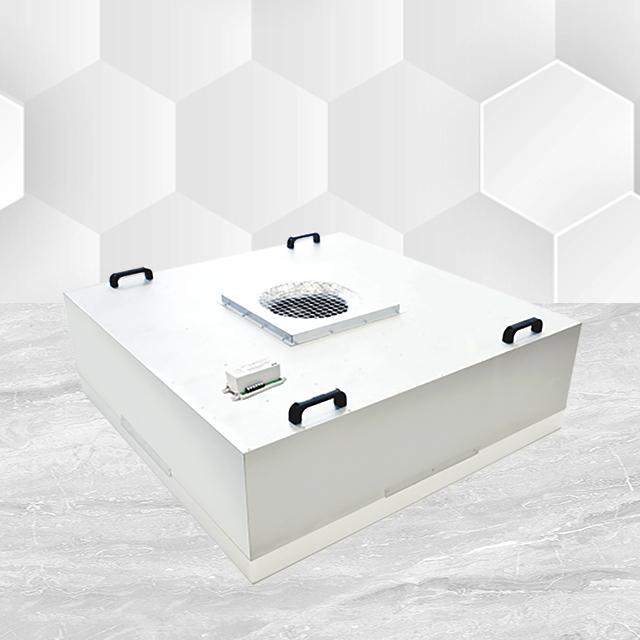
Cleanrooms rely heavily on localized air purification. We define this unit as an active, independent purification module. It combines a powerful fan system and high-efficiency filtration media into one single housing. These devices serve as your primary defense against harmful contamination. They actively pull air from a ceiling plenum, force it through dense media, and deliver particle-free air into the workspace below.
Traditional centralized Air Handling Units (AHUs) push massive volumes of air through extensive ductwork. This older system architecture lacks flexibility. If a central AHU fails, the entire cleanroom loses positive pressure. Modern facilities contrast this approach by using localized modular grids. Independent modules provide essential redundancy. If one motor fails, surrounding units compensate automatically to maintain critical environmental limits.
These individual units function collectively as a cohesive laminar flow ceiling module. They ensure unidirectional airflow across the entire production floor. Unidirectional air sweeps microscopic particulates away from critical process zones. It pushes contaminants directly down toward low-level wall returns. This uniform velocity prevents dead zones where particles might settle. It also eliminates dangerous air turbulence around sensitive equipment.
Understanding the basic hardware establishes baseline technical vocabulary. We break down the primary components below:
Housing Materials: Manufacturers typically form enclosures from lightweight aluminum, galvanized steel, or 304/316L stainless steel for specialized chemical resistance.
Motor and Blower Assembly: The internal centrifugal fan drives the air downward. It determines the energy efficiency and acoustic profile of the entire module.
Filtration Media: The integrated hepa fan filter captures 99.99% of particles at 0.3 microns, acting as the final physical barrier before air enters the room.
Pre-filters: Optional coarse filters capture larger dust particles before they reach the main media, significantly extending overall lifespan.
Motor technology defines cleanroom performance. Buyers typically choose between Alternating Current (AC) asynchronous motors and Electronically Commutated (EC) brushless DC motors. AC motors use magnetic fields generated by alternating current to spin the rotor. They are rugged and historically common. EC motors utilize built-in electronics to control voltage and current precisely. This fundamental technology gap impacts every operational metric.
Energy efficiency represents the most drastic difference. AC motors operate at roughly 50% to 60% electrical efficiency. They waste significant energy. EC motors frequently exceed 85% efficiency. They draw far less power to deliver identical air volumes. We must also consider the implementation reality regarding heat dissipation. AC motors generate excess sensible heat during continuous operation. They transfer this waste heat directly into the facility airflow. This inadvertently increases your HVAC cooling load. Conversely, an ec motor ffu operates much cooler. It saves money twice: first on direct fan power, and second on reduced air conditioning requirements.
Acoustic performance heavily influences operator comfort. Hundreds of fans spinning simultaneously create intense noise floors. AC units typically operate between 55 and 65 decibels (dBA) at standard static pressures. EC units operate much more quietly, often dropping below 50 dBA. Continuous exposure to 60+ dBA causes severe noise fatigue among cleanroom personnel. It reduces concentration and increases operational errors. Furthermore, AC motors generate more structural vibration. Facilities manufacturing sensitive semiconductors or operating electron microscopes demand strict vibration limits. EC technology inherently produces less mechanical resonance.
Control mechanisms separate modern automation from legacy manual labor. We compare them using the table below.
| Control Feature | AC Motor Technology | EC Motor Technology |
|---|---|---|
| Speed Adjustments | Limited to manual 3-speed switches (Low, Medium, High). | Continuous, granular variable speed control (0-100%). |
| Automation Capability | Requires physical intervention per unit at the ceiling level. | Seamless integration via BMS or specialized control software. |
| Pressure Compensation | Airflow drops as filters load; requires manual speed bumping. | Automatically adjusts RPM to maintain constant airflow as filters clog. |
| Digital Networking | Standalone operation only. Hard to monitor remotely. | Uses Modbus/RS485 networks for dynamic group control and zoning. |
Scalability requires digital intelligence. EC units integrate easily into facility-wide group control networks. You daisy-chain hundreds of modules using standard Modbus or RS485 protocols. A central computer monitors individual RPM, power draw, and filter resistance. As filter media traps particles over several years, static pressure increases naturally. The software tells the EC motor to spin slightly faster. It maintains the precise required airflow automatically. You never need to climb a ladder to flip a switch.
You cannot purchase equipment blindly. You must reverse-engineer your requirements based entirely on target ISO 14644 classes. An ISO 8 space requires entirely different specifications than an ISO 3 microelectronics fab. You match equipment directly to compliance mandates.
Air Changes Per Hour (ACH) dictates how many times the entire room volume passes through filtration media. High ACH rates require dense ceiling coverage. We outline standard baseline ratios in the chart below to guide your initial layout planning.
| ISO Class Limit | Target Air Changes Per Hour (ACH) | Estimated Ceiling Coverage Requirement |
|---|---|---|
| ISO 3 (Class 1) | 500 - 750 ACH | 100% (Full coverage) |
| ISO 5 (Class 100) | 240 - 480 ACH | 35% - 70% coverage |
| ISO 7 (Class 10,000) | 60 - 90 ACH | 15% - 20% coverage |
| ISO 8 (Class 100,000) | 10 - 20 ACH | 5% - 10% coverage |
Physical dimensions impact your structural grid. A standard 2x4 (2 feet by 4 feet) cleanroom ffu unit fits standard cleanroom ceiling grids easily. Some facilities use larger 4x4 sizes to minimize the total number of electrical connections. However, larger units carry significant weight. You must carefully calculate structural load capacities before selecting oversized modules.
Filter media selection presents another critical choice: HEPA versus ULPA. HEPA models capture 99.99% of particulates down to 0.3 micrometers. ULPA models capture 99.9995% down to 0.12 micrometers. Many engineers mistakenly assume tighter filtration is automatically better. This is a common mistake. ULPA media relies on incredibly dense glass fibers. This extreme density creates a massive penalty regarding static pressure. The motor must work significantly harder to push air through a ULPA barrier. Energy demands skyrocket accordingly.
We offer skeptical-friendly advice here: strongly warn your team against defaulting to ULPA models unless your process strictly dictates it. Semiconductor lithography or specific nanotechnology labs require ULPA. General pharmaceutical packaging or medical device assembly almost never do. Upgrading unnecessarily drives up initial purchase prices and guarantees higher monthly electricity bills.
Financial evaluations must look past the initial invoice. You face a transparent cost comparison between Initial CapEx (Capital Expenditure) and Long-Term OpEx (Operational Expenditure). EC technology carries a 20% to 30% higher upfront purchase price. However, modeled against standard facility operating hours, EC installations typically generate an energy return on investment within 18 to 24 months. After this break-even point, the facility saves thousands of dollars annually.
Maintenance logistics dramatically alter long-term expenses. Evaluating filter replacement methods is crucial. Older top-load designs force maintenance teams to access the ceiling plenum from above. Technicians must lift the heavy blower assembly out of the grid to swap the filter. This risks dropping contaminants into the room. It also demands significant operational downtime. Modern Room-Side Replaceable (RSR) designs solve this completely. Technicians unscrew a protective face panel from inside the room. They drop the old filter out and push a new one in. The motor and housing never move. RSR models cost slightly more initially but save countless hours of painful maintenance downtime.
Facility infrastructure constraints dictate what you can physically install. We recommend auditing three specific facility limitations before placing bulk orders:
Electrical Supply Infrastructure: Verify your power capabilities. Determine if your ceiling grid supplies single-phase (115V/277V) or three-phase power. AC motors often require specific voltage matches, whereas many modern EC units feature universal voltage inputs ranging from 200V to 277V.
Plenum Space Clearances: Older building retrofits often feature very tight ceiling plenums. Standard motor housings might not fit. You must actively source low-profile housing designs to accommodate restricted spaces without restricting return airflow.
Weight-Bearing Capacities: Suspended ceiling grids hold limited weight. Heavy steel units loaded with thick filters strain suspension wires. Aluminum housings reduce structural stress significantly.
Evaluating vendor proposals requires strict technical scrutiny. Marketing brochures often highlight optimal-condition metrics. You cannot base critical compliance decisions on theoretical numbers. Demand verifiable third-party testing data for every module model.
First, verify airflow uniformity across the filter face. A good module outputs air evenly. Poor designs blast air from the center and starve the edges. Second, demand certified leak test results. Aerosol testing guarantees the seal between the filter frame and housing remains airtight. Third, review acoustic ratings tested at specific static pressures, not just free-air operation.
Assess vendor scalability and post-installation support closely. Hardware matters, but localized control software matters equally. Evaluate the manufacturer's proprietary group control interfaces. Ensure they offer open-protocol options like Modbus so you can integrate them into existing facility software. Furthermore, inquire about replacement part availability. If a proprietary controller board fails, you need a replacement shipped immediately to prevent compliance deviations.
Material compatibility is a major consideration for biopharma and life sciences. Evaluate housing materials against your strict cleanroom sterilization protocols. Many sterile facilities use Vaporized Hydrogen Peroxide (VHP) or aggressive sporicidal chemical wipe-downs. Standard galvanized steel degrades and rusts under these harsh routines. You must specify 316L stainless steel enclosures to survive repeated chemical exposure without shedding particles.
Finalize your shortlisting logic by adopting the "More Cleanliness, Less Energy" verdict. Prioritize systems offering verifiable electrical efficiency gains without ever compromising strict environmental controls. A slightly cheaper AC unit becomes a financial liability after five years of 24/7 operation.
The industry has decisively shifted away from commoditized, cheap air filtration. Modern facility engineering prioritizes strategic, energy-optimized cleanroom management. Airflow delivery modules dictate both compliance and operational viability.
Evaluate power consumption realistically. EC technology clearly stands as the standard for future-proof, scalable, and compliant operations.
Prioritize maintenance access. Specifying room-side replaceable filter designs minimizes costly process disruptions.
Avoid over-specification. Match filter efficiencies strictly to your target ISO class to prevent unnecessary energy penalties.
While basic AC units occasionally serve budget-restricted, temporary environments, they fail to support modern, data-driven automation. We strongly encourage facility managers and procurement teams to request customized airflow modeling before finalizing any specifications. Conduct a thorough site-specific audit of your electrical infrastructure and cooling capacity today. Make informed, data-backed procurement choices to secure clean, profitable operations for the next decade.
A: A standard filter typically lasts between three to five years. However, this lifespan varies heavily based on your operating environment. If you utilize coarse pre-filtration to capture large dust particles before they reach the main media, you significantly extend its life. Continuous 24/7 runtime and high ambient particulate loads will shorten replacement cycles.
A: Yes, retrofitting is highly common. You must verify physical grid compatibility to ensure the new modules fit existing T-bar dimensions. However, you will likely need minor wiring upgrades. You must also run low-voltage networking cables across the ceiling plenum to integrate the new EC control systems properly.
A: A group control system connects all modules via a digital daisy-chain network. It assigns a unique digital address to every individual unit. This allows centralized monitoring from a single computer. The software automatically commands specific units to increase their RPM to compensate for pressure drops as filters load with particles.
A: Industry standards generally recommend maintaining background noise below 60 dBA to prevent operator fatigue. Most premium EC modules aim for 50 to 55 dBA per unit at standard operating pressures. Final room noise levels depend heavily on the total number of modules running and the room's specific acoustic reflection properties.


