 EnglishEnglish


Views: 0 Author: Site Editor Publish Time: 2026-10-09 Origin: Site


Unpredictable condensation remains the primary driver behind VHP cycle failures today. It silently extends aeration times in your facility. It triggers severe material compatibility issues. Worst of all, it ruins expensive validation runs. Finding success requires a delicate operational balance. You must manage ambient temperature, starting humidity, and vapor injection rates carefully. If one variable shifts, the entire decontamination cycle can collapse.
Our objective here is highly straightforward. We want to bridge the gap between the complex physics of vapor saturation and your practical, daily operations. You face critical facility-level decisions regularly. You need reliable ways to evaluate new equipment. You must integrate these units seamlessly into existing rooms. Finally, you have to validate these systems with absolute confidence. By understanding the underlying thermodynamics, you can prevent cycle deviations before they begin.
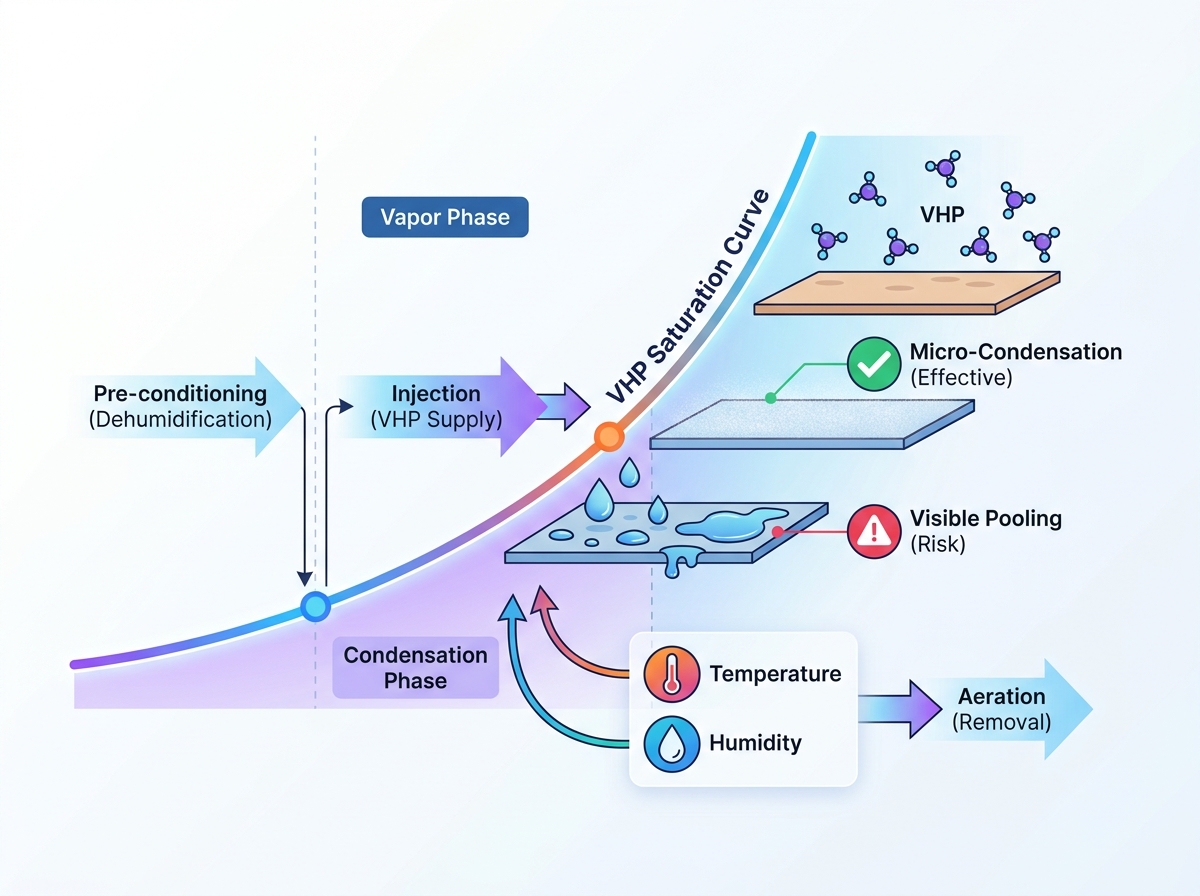
Thermodynamic Limits: VHP cycles operate on a strict psychrometric curve; exceeding the saturation point inevitably triggers condensation.
Micro-Condensation vs. Pooling: While invisible micro-condensation is often necessary for achieving a 6-log microbial reduction, visible pooling indicates a loss of process control and risks asset degradation.
Evaluation Priority: Effective VHP condensation control requires evaluating a vendor's dehumidification capacity and sensor accuracy just as heavily as their peak vapor output.
HVAC Dependency: Standalone VHP generators frequently fail without proper facility HVAC integration for pre-conditioning and aeration phases.
Understanding vapor physics establishes the foundation for any successful decontamination strategy. We must define the physical laws governing vaporized hydrogen peroxide clearly. Let us skip the overly academic theory. Instead, focus on the practical thermodynamic limits you face.
Standard relative humidity measures only water vapor in the air. However, a decontamination cycle uses a mixed-gas environment. You are dealing with both water vapor and hydrogen peroxide vapor. Monitoring true VHP relative humidity requires tracking this specific mixed-gas relative saturation. The air can only hold a specific amount of this gas mixture before it saturates. Once you hit 100% relative saturation, the gas must revert to a liquid state.
Temperature directly dictates how much vapor the air can hold. Warm air holds more vapor. Cold air holds less. When temperature drops in specific room zones, the threshold for liquid formation plummets. We call these areas cold spots. Windows, cold stainless steel surfaces, and uninsulated ducts act as dangerous condensation traps. The vapor hits these cold surfaces, reaches its local dew point, and condenses instantly.
Industry consensus generally accepts that some condensation always occurs. General pharmaceutical science standards point to a specific mechanism. A sub-micron layer of condensation drives the primary biocidal activity. This invisible micro-condensation layer destroys bacterial spores efficiently. You cannot see it with the naked eye. However, you must distinguish this beneficial micro-layer from detrimental macroscopic pooling. Visible droplets mean you have pushed the room past its physical limits.
We must frame this technical problem into measurable business risks. When thermodynamics fail, your operational efficiency suffers immediately. You face tangible financial and scheduling consequences.
When macroscopic hydrogen peroxide vapor condensation occurs, operations grind to a halt. Liquid pooling creates massive aeration bottlenecks. Off-gassing liquid takes significantly longer than purging a dry gas. A standard two-hour aeration phase can easily stretch into twelve hours. This delay severely impacts facility uptime. It disrupts production schedules and wastes expensive labor hours.
Visible pooling poses severe asset risks across your facility. Liquid hydrogen peroxide is a highly reactive oxidizer. When it pools, it causes rapid oxidative damage. It aggressively attacks epoxy floor coatings. It degrades sensitive electronics and ruins specific medical-grade polymers. Over time, repeated liquid exposure leads to premature equipment failure. You end up replacing costly assets far earlier than expected.
Pooling leads directly to compliance nightmares and validation failures. Liquid droplets can cover Biological Indicators (BIs). This liquid barrier prevents the gas from penetrating the Tyvek pouch properly. Chemical Indicators (CIs) will also yield inconsistent color changes. These failures trigger costly Root Cause Analyses (RCAs). You must investigate the deviation thoroughly. Following the RCA, you must completely re-develop the cycle parameters from scratch.
You must shift your focus to decision-stage criteria. Equip yourself to evaluate vendor claims critically. Not all generator systems handle thermodynamics equally.
Guide your buying team to scrutinize the system’s desiccant or cooling capabilities. The pre-conditioning phase is arguably the most critical step. A system cannot prevent liquid formation if it fails to establish a low baseline humidity first. Heavy-duty desiccant wheels pull moisture out of the air rapidly. Check the cubic feet per minute (CFM) rating of the dehumidification circuit. High-volume rooms require aggressive moisture removal before injection begins.
Evaluate how systems step down their injection rates dynamically. As relative saturation approaches 100%, the system must react. You must avoid "dumb" timer-based injection methods. Timer-based systems pump gas blindly, regardless of the room conditions. Demand closed-loop, sensor-driven modulation instead. A smart system reads the room data. It automatically slows the injection pump to prevent surpassing the dew point.
Standard humidity sensors fail miserably in mixed-gas environments. They read the hydrogen peroxide gas as extra water vapor, skewing the data. Advise your engineering team to specify catalytic or near-infrared (NIR) sensors. They accurately read true gas concentrations. This specific hardware guarantees effective VHP condensation control.
| Sensor Type | Mixed-Gas Accuracy | Primary Application | Risk Level |
|---|---|---|---|
| Standard Capacitive Humidity | Low | Basic HVAC monitoring | High (False readings) |
| Catalytic Sensors | High | Low concentration monitoring | Low |
| Near-Infrared (NIR) | Very High | Real-time high concentration mapping | Minimal |
Implementing new equipment introduces practical realities and risks. You cannot ignore the physical environment itself. The room geometry dictates your success.
Standalone mobile units often struggle in large pharmaceutical volumes. They simply lack the airflow capacity to manage massive spaces alone. They require building management system (BMS) integration. Discuss the necessity of utilizing facility HVAC units. You need the house air handling unit (AHU) for rapid dehumidification. You also rely heavily on it for post-cycle aeration. When the generator and the BMS talk to each other, cycle times drop dramatically.
Conduct temperature mapping studies prior to cycle development. Do not skip this step. Identify cold spots early because they act as severe vapor traps.
Place data loggers throughout the target room in a grid pattern.
Record ambient temperatures over a full 24-hour operational cycle.
Identify the top three coldest locations in the room.
Designate these cold zones as your worst-case testing locations.
Assess how room geometry impacts vapor homogeneity. Dead legs and L-shaped hallways trap gas. HEPA filter placement dictates how the gas enters and exits the space. Use supplemental circulation fans strategically. Point fans toward known cold spots. They prevent localized super-saturation by keeping the gas moving. Continuous airflow stops the vapor from settling and forming visible liquid.
You must align your operational capabilities with strict regulatory expectations. FDA and GMP frameworks demand rigorous proof of efficacy. You cannot validate a broken process.
Establish clear pass/fail metrics for visible condensation. You must define this during Cycle Development (CD) and Performance Qualification (PQ). A common Standard Operating Procedure (SOP) requires a visual inspection with a flashlight. Operators check stainless steel surfaces immediately after the dwell phase. If they observe pooling or running droplets, the cycle parameters fail. You must adjust the injection rate downward and re-test.
Explain why worst-case locations matter deeply. You must place biological and chemical indicators in identified cold spots. Put them under equipment. Place them in upper corners away from the distribution fans. Proving process efficacy in challenging micro-environments guarantees the rest of the room is sterile. If a BI dies in the coldest, hardest-to-reach corner, you have validated the entire space successfully.
Logging data proves you maintained control. Maintain strict documentation and 21 CFR Part 11 compliant audit trails. Log real-time temperature, relative saturation, and gas ppm continuously. You must prove the cycle remained within validated parameters mechanically. Do not rely solely on end-of-cycle biological results. A dead BI means nothing if your environmental parameters swung wildly out of specification during the dwell phase.
Provide your buying team with a clear, actionable framework. Evaluating new equipment or service providers requires strict logical criteria.
Use a decision matrix to choose between fully integrated systems and mobile generators. Base your decision on room volume and cycle frequency.
Mobile Units: Best for infrequent cycles, small cleanrooms, and facilities needing multi-room flexibility.
Integrated Piped Systems: Best for daily high-frequency cycles, massive production suites, and automated pass-through chambers.
You must interrogate your potential vendors. Ask them specific technical questions. Do not accept vague marketing answers.
How exactly does your proprietary algorithm step down injection before reaching the dew point?
What specific sensor technology do you use to measure relative saturation in a mixed-gas environment?
What are the annual calibration requirements for your internal sensors, and can our team perform them on-site?
Recommend demanding a localized mock-up from vendors. For complex or high-risk facilities, request a Computational Fluid Dynamics (CFD) study. A CFD study models the airflow and vapor distribution digitally. It shows you exactly where the gas will pool before you purchase the equipment. Demand this proof of concept before signing final procurement documents.
Mastering vapor distribution is less about maximizing chemical output and entirely about mastering environmental thermodynamics. Pumping more gas into a room rarely solves decontamination failures. It usually creates worse pooling problems. Successful procurement relies heavily on selecting equipment with robust pre-conditioning capacities. It demands precise, mixed-gas sensor feedback. Finally, it requires seamless facility HVAC integration to manage aeration.
You have the knowledge to evaluate vendors critically. Take action now. Download a specific validation checklist for your facility type. Request a comprehensive facility site assessment from a qualified vendor. Consult with a validation engineer to map your thermal cold spots today. Control your environment, and you will control your outcomes.
A: Relative humidity measures only water vapor in the air. Relative saturation measures a mixed-gas environment containing both water vapor and hydrogen peroxide vapor. You must track relative saturation to determine the true condensation point during a decontamination cycle.
A: Yes, macroscopic pooling is unnecessary. However, current scientific consensus shows that a sub-micron, invisible layer of micro-condensation occurs. This microscopic layer is where the primary biocidal activity takes place, effectively killing spores without leaving visible liquid behind.
A: You can pre-heat the equipment slightly by raising the room temperature before the cycle. Ensure proper load configuration to allow airflow. Finally, direct supplemental circulation fans specifically at the cold stainless steel surfaces to prevent vapor from settling.
A: Yes. While vapor passes through filter media safely, liquid pooling wets the fibers. Wet HEPA filters suffer degraded structural integrity. Liquid saturation can block airflow entirely, increasing pressure drops and potentially ruining the expensive filter media.


