 EnglishEnglish


Views: 0 Author: Site Editor Publish Time: 2026-10-20 Origin: Site


Biodecontamination facility design carries exceptionally high stakes. Selecting the wrong system architecture leads to cycle inefficiencies, prolonged downtime, and complex validation failures. You cannot afford missteps in highly regulated environments. Facility managers and quality engineers face a critical crossroad. They must choose between deploying mobile standalone units for localized treatment versus engineering a permanently integrated solution. This decision dictates how your team manages daily operations. It also determines long-term resource allocation.
Our objective is to provide a realistic, evidence-based framework for evaluating both architectures. We will analyze capital allocation, operational workflows, and stringent regulatory compliance. You will understand how GMP guidelines and BSL-3 containment requirements influence these choices. Ultimately, this guide helps you align system mechanics directly to your specific facility goals. You can then confidently navigate your next facility upgrade or new build project.
Standalone whole-room VHP offers deployment flexibility and lower initial CapEx but demands higher manual setup and longer cycle times.
HVAC integrated VHP sterilization minimizes operator intervention and accelerates aeration, but requires stringent facility prerequisites (e.g., bubble-tight dampers, compatible ductwork).
The decision hinges on facility age (greenfield vs. retrofit), required frequency of decontamination, and the complexity of the existing Building Management System (BMS).
Validation (IQ/OQ/PQ) complexity scales significantly with HVAC integration due to air-handling variables and dead-leg risks.
Understanding your operational baseline is the first critical step. You must clarify the difference between routine room turnover and facility-wide automated sterilization. Routine turnover happens frequently. It usually involves single rooms between product batches. Facility-wide sterilization often happens during annual maintenance shutdowns. It requires coordinating multiple zones simultaneously.
Facilities often underestimate the hidden costs behind these systems. Managers frequently miscalculate the extensive labor required for manual VHP deployment. Operators spend hours taping doors and sealing registers. Conversely, engineers often underestimate the complex integration costs of automated systems. Modifying existing ductwork demands significant engineering oversight.
A successful decontamination strategy must meet strict success criteria. First, you need proven biological efficacy. Regulatory bodies expect a consistent 6-log reduction of bioburden. Second, material compatibility remains non-negotiable. Harsh sterilants degrade cheap plastics and inferior metals. Third, you need cycle repeatability. Your process must yield identical results every single time. Finally, operator safety always takes precedence. Evaluating whole room VHP decontamination requires balancing these exact criteria against your daily throughput demands.
Mobile whole-room generators operate independently from your facility infrastructure. These standalone units introduce vapor directly into the target space. They rely on localized fans for vapor distribution. Operators wheel the equipment into the room. They position it strategically to ensure optimal coverage.
This architecture offers several primary advantages. The barrier to entry remains relatively low. Capital expenditure for mobile units is significantly less than permanent installations. You also gain high agility. Your team can move units across different cleanrooms or containment labs. This flexibility proves ideal for legacy facilities. Retrofitting ductwork in older buildings is often structurally impossible or financially unfeasible.
However, you must accept specific operational trade-offs. Mobile units demand intense manual preparation. Operators follow a rigorous process before every cycle.
Mapping the target space for optimal fan placement.
Manually sealing all HVAC registers and exhaust grilles.
Taping door seams and wall penetrations.
Positioning external aeration scrubbers.
Extended setup phases impact facility uptime. Conditioning and aeration phases also take longer. Inconsistent vapor distribution often occurs in complex geometries. L-shaped rooms or spaces packed with heavy equipment create shadow zones. You must deploy supplemental circulation fans to reach these cold spots.
Best Practice: Always perform a smoke test during the initial setup. This reveals dead zones requiring additional fan support.
Common Mistake: Relying solely on the generator's internal fan for large rooms. This practice almost guarantees biological indicator failures in distant corners.
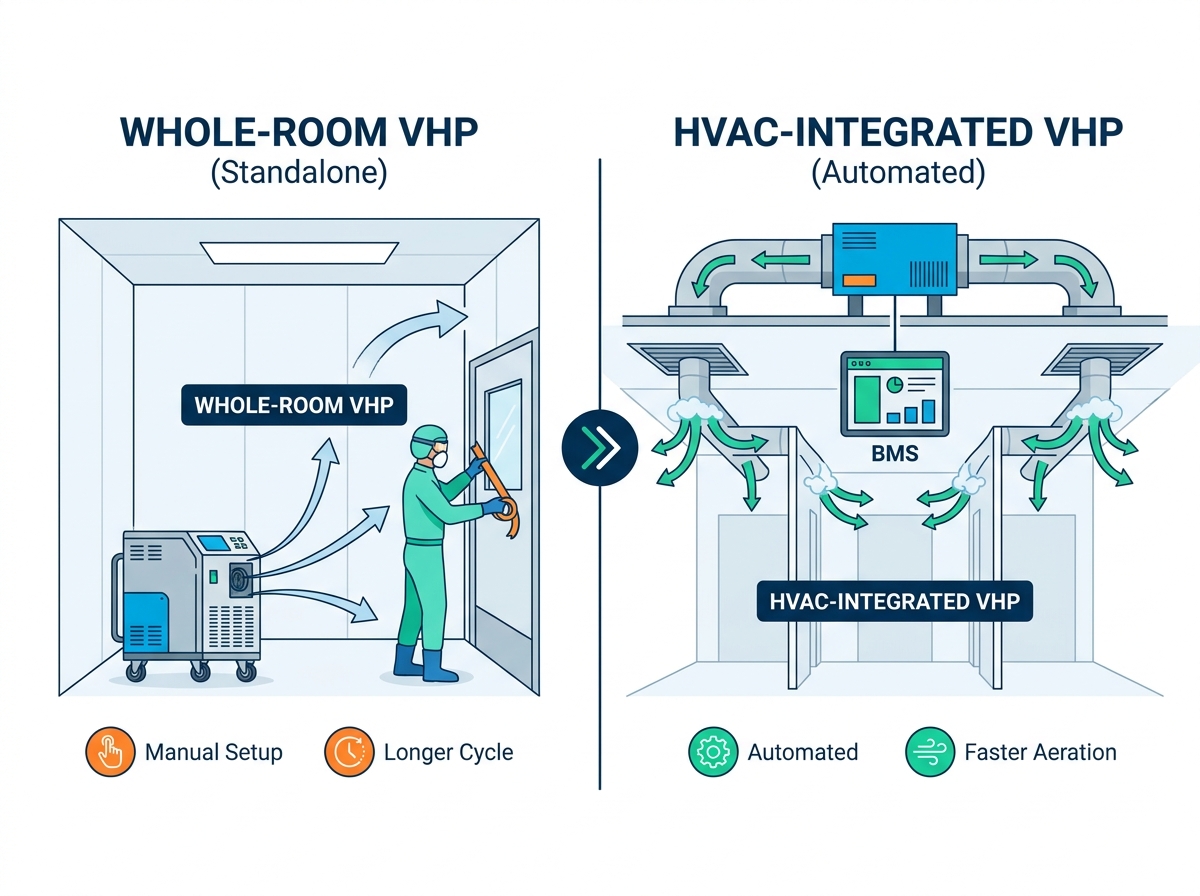
Integrated systems fundamentally change the decontamination paradigm. An HVAC integrated VHP sterilization system injects vapor directly into the facility air handling unit (AHU). It can also inject vapor into the main supply ductwork. This method utilizes existing infrastructure for vapor distribution and subsequent aeration. The entire process becomes an engineered function of the building itself.
The primary advantages center around speed and safety. You achieve rapid, automated cycle execution. The system links directly to your Building Management System (BMS). Operators initiate cycles via digital interfaces outside the containment zone. You also experience significantly faster aeration times. The system utilizes the HVAC exhaust capabilities to pull vapor out rapidly. This entirely eliminates manual room sealing. Automated dampers handle the isolation. Operator exposure risk drops to near zero.
These benefits come alongside harsh engineering realities. Integrated systems require strict control over internal parameters. You must manage temperature, humidity, and airflow precisely within the ductwork. If temperatures drop too low, localized condensation occurs. Liquid hydrogen peroxide pools in duct branches. This pooling damages materials and ruins the sterilization cycle.
Furthermore, this architecture demands robust material compatibility. Standard galvanized steel degrades quickly under frequent vapor exposure. You must use 316L stainless steel across all exposed HVAC components. Sealants and gaskets must also resist oxidation. Upgrading these components requires significant upfront planning and capital.
Best Practice: Pre-condition the ductwork air before vapor injection. Lowering the relative humidity increases the dew point margin.
Common Mistake: Ignoring the exact length of duct runs. Long runs cause vapor degradation before the sterilant ever reaches the target room.
Evaluating these systems requires a balanced matrix. You must weigh immediate capital expenditure against long-term operational costs. Mobile units require less cash upfront. However, they consume more labor hours over time. You pay operators for setup, breakdown, and monitoring. Integrated systems require massive initial capital. Yet, they reduce daily labor costs and minimize facility downtime. Faster turnover equals more production batches per year.
| Evaluation Parameter | Whole-Room Mobile VHP | HVAC-Integrated VHP |
|---|---|---|
| Initial Capital Expenditure | Low to Moderate | High |
| Setup Time per Cycle | 1 to 3 hours (Manual) | Under 10 minutes (Automated) |
| Aeration Speed | Slow (relies on local scrubbers) | Fast (uses building exhaust) |
| Validation Complexity | Moderate | Highly Complex |
| Facility Modification Needed | Minimal | Extensive (Dampers, 316L SS) |
Validation complexity scales significantly based on your choice. Installation Qualification (IQ), Operational Qualification (OQ), and Performance Qualification (PQ) vary wildly. Whole-room validation focuses mostly on the generator itself. You perform rigorous mapping of Biological Indicators (BIs) and Chemical Indicators (CIs) in room cold spots. The process is straightforward but tedious.
Conversely, integrated systems demand highly complex OQ/PQ phases. You must validate the BMS software handshakes. You must prove damper seals hold pressure. Regulators require evidence of uniform vapor distribution across long duct runs. You must prove concentration does not degrade before reaching the final diffuser. Validating air-handling variables adds weeks to the project timeline.
Security and compliance also drive this decision. High-containment environments like BSL-3 or BSL-4 facilities face intense scrutiny. A well-designed VHP HVAC sterilization system offers superior boundary control. Automation eliminates human error during sealing. The BMS provides unalterable digital audit trails for every cycle. This level of traceability satisfies the most demanding regulatory inspectors.
Integrating vapor technology into a new build differs fundamentally from retrofitting older spaces. Greenfield projects allow engineers to design for vapor compatibility from day one. They specify welded stainless ducts, precise sensor placements, and optimal AHU sizing. Brownfield projects present massive challenges. Retrofitting a 15-year-old facility often uncovers hidden architectural flaws. Old ductwork leaks. Existing dampers fail under pressure testing.
You must perform a comprehensive HVAC infrastructure health check before committing to an integrated setup. This evaluation dictates your project feasibility.
Assessing duct leakage rates: Standard commercial ducts leak too much vapor. You must pressure-test the entire run to ensure containment.
Verifying isolation dampers: Standard dampers cannot stop vapor migration. You must install true gas-tight or bubble-tight isolation dampers.
Evaluating sensor placement: Accurate control requires precise data. You must place temperature and relative humidity sensors directly within the air stream.
Reviewing duct routing: Sharp bends and sudden expansions cause pressure drops. These drops trigger localized condensation.
Implementation risks run high during retrofits. Condensation remains the most common pitfall. Liquid peroxide causes severe material degradation. It eats through seals and corrodes fan blades. More importantly, condensation depletes the vapor concentration in the air. This leads directly to incomplete sterilization in distant duct branches. BIs will fail, and your facility will not pass PQ.
If your infrastructure fails this health check, standalone mobile units become the safest logical choice. Do not force integration into an incompatible building.
Neither system architecture is universally superior. Your choice is dictated purely by facility throughput demands and infrastructure readiness. You must align your investment with your actual operational needs.
For shortlisting logic, recommend whole-room mobile units for infrequent decontamination. They perfectly suit legacy spaces and smaller research labs. Conversely, recommend HVAC integration for high-throughput environments. Automated systems dominate in large pharmaceutical manufacturing lines and new BSL-3 builds.
Your next steps require deliberate action. Initiate a pre-implementation feasibility study before engaging vendors. Map your spaces in 3D to identify complex geometries. Conduct a thorough material audit of your existing HVAC components. Presenting these findings to your engineering team ensures a seamless, compliant, and highly effective sterilization strategy.
A: Yes, but it requires extensive modification. You must upgrade standard dampers to bubble-tight isolation dampers to prevent vapor leakage. You also need a comprehensive material compatibility audit. Standard galvanized steel degrades quickly. You must replace exposed components with 316L stainless steel and vapor-resistant gaskets.
A: Integrated systems aerate significantly faster. They utilize the massive air-handling capacity of the facility exhaust to purge vapor outdoors rapidly. Standalone systems rely on localized carbon scrubbers. These scrubbers process air much slower, adding hours to the total cycle time.
A: No, the BIs remain the standard Geobacillus stearothermophilus spores. However, the placement strategy shifts entirely. You must place BIs inside the supply ductwork, behind dampers, and within the AHU internals. This proves the vapor maintained efficacy throughout the entire air path.
A: The BMS acts as the brain of the integrated cycle. It automates pressure cascades and controls bubble-tight dampers. It also monitors real-time temperature and humidity to prevent condensation. Furthermore, the BMS enforces safety lockouts, ensuring no personnel can enter the zone during active injection.


