 EnglishEnglish


Views: 0 Author: Site Editor Publish Time: 2026-10-06 Origin: Site


Accurate VHP (Vaporized Hydrogen Peroxide) generator sizing acts as the critical bridge between achieving a reliable 6-log bio-decontamination and maintaining highly profitable facility uptime. Many facility managers assume a quick glance at floor plans is enough. However, effective sizing demands much more. You must execute a systemic calculation of net room volume, material load absorbency, HVAC leakage, and environmental baselines. Relying on rough estimates puts your entire sterile manufacturing operation at severe risk.
Meeting strict GMP and FDA compliance standards heavily depends on this exact mathematical precision. Proper sizing prevents costly cycle failures resulting from undersized equipment struggling to maintain gas concentration. It also avoids severe condensation issues or extended aeration delays caused by oversizing. In this comprehensive guide, we will walk you through the fundamental steps to evaluate your cleanroom dynamics. You will learn how to accurately match your facility's unique physical parameters to the correct generator capacity, ensuring consistent, rapid, and compliant sterilization cycles every single time.
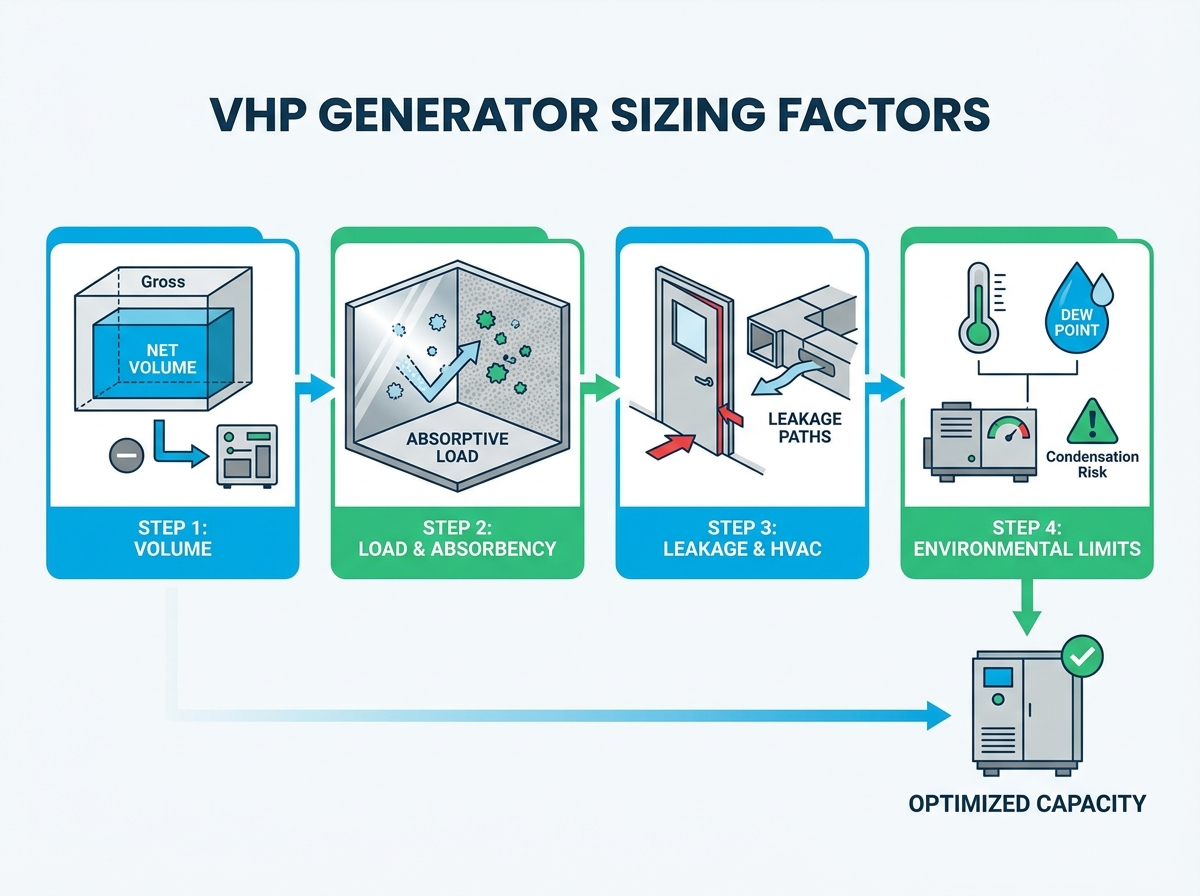
Baseline metrics are insufficient: True cleanroom VHP decontamination volume must account for deducts (equipment) and additions (HVAC ductwork).
Load determines consumption: High-density surface areas and absorptive materials deplete VHP concentrations rapidly, requiring higher injection rates.
Leakage is inevitable: VHP generator capacity calculations must include safety margins for dynamic HVAC sealing and structural leakage.
Oversizing carries risks: Specifying excessive capacity without calculating dew points leads to micro-condensation, material degradation, and extended aeration phases.
Choosing the wrong unit disrupts your entire manufacturing schedule. Undersizing and oversizing both create severe operational bottlenecks. You must understand these risks to justify a rigorous sizing protocol.
An undersized unit consistently fails to reach target ppm concentrations. It struggles to maintain lethal gas levels during the critical exposure phase. This leads directly to failed biological indicator (BI) challenges. Failed BIs trigger mandatory, complex, and lengthy re-validations. Furthermore, undersized equipment extends the initial conditioning and injection phases. The generator works overtime to build concentration. These unnecessary delays consume valuable production time and stall batch releases.
Oversizing might seem like a safe buffer. However, excessive capacity introduces serious compliance and operational risks. First, you risk unnecessary capital expenditure on massively oversized equipment. Second, excess capacity increases the likelihood of vapor saturation. Rapid saturation causes micro-condensation on cold surfaces. This micro-condensation leads to severe equipment corrosion over time. Most importantly, oversized units dramatically extend aeration times. It takes significantly longer to off-gas liquid peroxide than vapor. This creates massive production bottlenecks.
Accurate spatial calculation sets the foundation for your entire sterilization strategy. Relying on simple architectural drawings often leads to critical errors in dosing.
You must begin by measuring total physical dimensions. Multiply length, width, and height. This establishes the gross baseline volume. However, you cannot use this gross number for precise sizing. You must subtract the volume of large, permanently sealed equipment. Items like biosafety cabinets, large stainless steel tanks, or heavy lyophilizers occupy space. Removing their volume from the total calculation gives you the net treatable space.
True cleanroom VHP decontamination volume requires more than basic room dimensions. If the cycle decontaminates the HVAC system simultaneously, you must add ductwork volume. Calculate the internal volume of all supply and return ducts. Furthermore, you must include several interstitial spaces:
Material pass-throughs and transfer hatches.
Personnel airlocks and gowning chambers.
HEPA filter housings and terminal plenums.
These hidden additions drastically alter your baseline volumetric calculation.
Do not rely on linear volume-to-capacity ratios. Many vendors offer simple sizing charts based solely on square footage. Avoid these generic estimates entirely. Volume is merely the starting point. It only helps you calculate the theoretical mass of hydrogen peroxide needed. Real-world sizing requires you to look beyond simple geometry and assess the actual environment.
Volume alone does not dictate hydrogen peroxide consumption. The physical items inside the room play a massive role in how the vapor behaves.
You must assess the density of equipment inside your cleanroom. High surface-to-volume ratios present a unique challenge. An empty room requires far less vapor than a room packed with machinery. A space filled with wire racks, equipment carts, and complex processing tools demands extra sterilant. You need extra vapor to effectively coat every exposed square inch. High-density spaces deplete VHP concentrations rapidly, demanding robust generator output.
Different materials interact with hydrogen peroxide vapor differently. You must categorize your cleanroom surfaces carefully.
Non-porous surfaces: Materials like 316L stainless steel and tempered glass reflect vapor. They do not absorb the chemical. These resilient surfaces require standard dosing protocols.
Absorptive surfaces: Plastics, polycarbonates, and specific epoxies behave completely differently. Materials like PVC act as active vapor sinks. They literally pull the sterilant out of the air. This rapid absorption lowers the effective ppm concentration in the room.
Rooms containing high absorptive loads need powerful equipment. You need generators capable of sustained, high-rate injection (measured in g/min). High injection rates overcome continuous material absorption. This ensures the room still reaches and maintains lethal microbial concentrations. If your generator cannot outpace the room's absorption rate, the entire cycle fails.
No cleanroom is perfectly sealed. Gas constantly escapes through microscopic gaps and mechanical pressure differentials. You must engineer safety margins into your equipment profile.
Identify inherent loss points early in the design phase. Inspect door sweeps and pass-through seals closely. Examine wall penetrations around pipes, conduits, and electrical fixtures. Even highly advanced cleanrooms experience minor structural leakage. You must account for this continuous loss of sterilant during the exposure phase.
HVAC dampers present a major leakage risk. You must account for bubble-tight versus standard dampers. Bubble-tight dampers provide a near-perfect mechanical seal. Standard dampers, however, inherently leak under pressure. They slowly bleed active vapor into adjacent corridors or interstitial spaces. This bleeding dilutes your active concentration, forcing the generator to work harder.
Sometimes a cleanroom must maintain negative pressure during decontamination to protect surrounding areas. This dynamic poses a significant challenge. The exhaust system continuously pulls sterilant out of the room. Your VHP generator capacity calculation must heavily compensate for this continuous loss. The unit must inject gas significantly faster than the exhaust removes it. Otherwise, you will never achieve the required 6-log bio-burden reduction.
The physical environment strongly dictates how vapor behaves. You must monitor and control temperature and humidity closely.
Decontamination efficacy relies entirely on hydrogen peroxide remaining in a vapor phase. The starting room temperature dictates saturation limits. Relative humidity (RH) determines exactly how much vapor the air can hold. If you push too much vapor into a cool, humid room, you exceed the dew point. The vapor immediately condenses into a hazardous liquid.
High baseline humidity requires integrated room dehumidification. Humid air simply cannot hold enough sterilant. Your sizing strategy must account for dehumidification time.
Assess the room's baseline ambient relative humidity.
Determine the target RH needed before injection (typically 10-30%).
Ensure the generator has the internal desiccant capacity to handle the moisture load.
You must achieve this dry state before the injection phase begins.
Generator capacity must be carefully throttled. You must balance the injection rate against the room's specific temperature profile. Push the system too hard, and you cross the saturation threshold. Micro-condensation leads directly to massive aeration delays.
| Environmental Variable | Impact on VHP Vapor State | Required Generator Adjustment |
|---|---|---|
| High Baseline Humidity (>50% RH) | Air cannot hold sufficient VHP; risks rapid condensation. | Requires extended pre-conditioning (dehumidification) phase. |
| Low Ambient Temperature (<20°C) | Lowers the dew point; vapor condenses much faster. | Requires lowering the injection rate (g/min) to prevent saturation. |
| High Ambient Temperature (>25°C) | Raises the dew point; allows higher VHP concentrations. | Allows for maximum injection rates; faster cycle times. |
Once you gather your physical data, you must evaluate equipment specifications. Select a unit that aligns with your calculated operational constraints.
Always match the generator's output curve against your total calculated needs. You must combine volume, load, and leakage requirements. Proper VHP generator sizing relies heavily on this specific grams-per-minute metric. High output capacity ensures you can overcome absorptive sinks and structural leaks rapidly.
Evaluate building management system (BMS) connectivity. You should ideally connect your unit to an environmental management system (EMS). Automation allows for highly precise cycle control. It triggers HVAC dampers automatically. It also provides essential data logging for strict regulatory audits.
You must choose between portability and centralized power.
Mobile units: These work best for multi-room facilities requiring flexibility. They suit spaces with completely isolated HVAC systems. You must size the mobile unit based on the largest, most challenging room on site.
Integrated units: These systems handle complex, centralized decontamination. They permanently connect to the facility's HVAC. They require highly complex sizing for simultaneous multi-zone distribution.
Ensure your chosen vendor provides robust regulatory documentation. You need comprehensive installation, operational, and performance qualification protocols. Strong vendor engineering support simplifies initial cycle development. It guarantees long-term regulatory compliance.
Accurate VHP equipment selection requires a holistic, mathematical approach. Simple volume calculations only set your baseline requirement. Material load absorbency and structural leakage dictate the necessary injection capacity. Finally, environmental factors like temperature and humidity establish your operational safety limits.
We strongly recommend conducting a professional site audit. Run a detailed engineering study before finalizing any procurement decisions. This critical step validates your assumptions regarding HVAC leakage and material absorbency.
Take decisive action today to protect your facility. Engage a validation engineer or specialized equipment vendor. Have them perform a preliminary capacity calculation based on your specific architectural schematics. This ensures consistent, compliant, and highly efficient decontamination cycles.
A: Lower temperatures reduce the amount of VHP the air can hold. A high-capacity generator may cause rapid condensation if not properly controlled in a cool room. You must match the injection rate to the room's exact temperature profile. This careful balancing keeps the sterilant safely in the vapor phase.
A: Yes, you can use one mobile unit across a facility. However, you must size the generator for the largest, most heavily loaded room. You then develop separate, validated cycle parameters for each smaller room. This strict control prevents oversaturation and long aeration times in smaller spaces.
A: Prolonged aeration is typically a symptom of oversizing the injection rate. It can also result from underestimating material absorbency. Both issues lead to invisible micro-condensation on room surfaces. Liquid peroxide takes exponentially longer to off-gas than vapor, drastically extending your aeration times.
A: Capacity generally refers to the total volume of space the unit can theoretically treat. Injection rate, measured in grams per minute (g/min), defines delivery speed. It indicates exactly how fast the unit can deliver hydrogen peroxide to overcome material load and structural leakage.


