 EnglishEnglish


Views: 0 Author: Site Editor Publish Time: 2026-07-14 Origin: Site


Designing a controlled environment leaves no room for guesswork. A single misstep in specifying the terminal HEPA filter for HVAC cleanroom systems jeopardizes ISO compliance. Facilities face massive operational risks. Product yields can drop instantly. Operational budgets inflate when systems fail. Engineers face a difficult bottom-of-funnel decision during the design phase. You must balance stringent particulate control against rigid system limits. Choosing between an H13 and H14 grade directly impacts your available static pressure. It also dictates your airflow volume capabilities. You cannot simply default to the highest efficiency rating. This article provides an evidence-based framework for your specification process. We unpack critical technical specifications and system integration constraints. You will learn how to align filter grades with regulatory mandates. We show you how to protect your system performance while maintaining strict environmental control.
Efficiency vs. Resistance: While H14 offers 10x lower penetration at MPPS than H13, it introduces significantly higher airflow resistance, necessitating careful HVAC fan curve analysis.
Compliance Alignment: H13 is typically sufficient for ISO Class 7 and 8 environments, whereas H14 is the baseline for ISO Class 5 and stricter GMP conditions.
Verification is Mandatory: Regardless of grade, post-installation PAO/DOP leak testing is required to validate the structural integrity of the air filter housing and seal.
Unpack why defaulting to the highest efficiency filter creates problems. Many engineers assume maximum filtration guarantees better performance. This represents a highly flawed engineering strategy. Upgrading an air filter beyond necessary specifications introduces severe system bottlenecks. An over-specified filter chokes the air handler. It reduces the vital air changes per hour (ACH). Lower ACH allows rogue particles to linger in the room. This paradoxically ruins your cleanroom classification.
Tie filter selection directly to regulatory stakes. ISO 14644-1 mandates specific airborne particulate limits for every class. FDA cGMP guidelines require strict environmental control for pharmaceutical manufacturing. Grade A and Grade B zones demand pristine air quality. Semiconductor fabrication plants require flawless yield protection. Airborne molecular contamination destroys microchips instantly. You must align your filter choice directly to these specific industry mandates. Guesswork invites audit failures.
Introduce the primary conflict in cleanroom design. A massive trade-off matrix exists in every facility. You must balance particulate capture efficiency against energy consumption. Every air handling unit faces strict system static pressure limits. Pushing air through a dense micro-glass medium requires immense energy. The blower motor must overcome this resistance continuously. Selecting an unnecessarily dense filter wastes electricity. It strains mechanical components prematurely. You must find the precise equilibrium between required cleanliness and mechanical capability.

We evaluate these filters using strict standardized criteria. The EN 1822 and ISO 29463 frameworks govern these classifications globally. They measure efficiency based on the Most Penetrating Particle Size (MPPS). This particle size typically falls between 0.12 and 0.3 microns. Particles of this size evade physical interception. They also resist diffusion mechanisms. They represent the ultimate test for any filter media.
The H13 grade provides a minimum efficiency of 99.95% at MPPS. This means only 50 particles out of 100,000 penetrate the media. You will typically deploy these units in ISO Class 7 and 8 environments. Common applications include gowning rooms and material transfer airlocks. Secondary pharmaceutical packaging areas also rely heavily on H13 elements. They offer excellent baseline protection without crippling system airflow.
The H14 grade delivers a much stricter minimum efficiency. It captures 99.995% of particles at MPPS. Only 5 particles out of 100,000 slip through. This represents a tenfold decrease in penetration compared to H13. They serve as the mandatory baseline for ISO Class 5 spaces. Operating theaters and sterile compounding pharmacies require this level of protection. Microelectronics fabrication zones strictly mandate H14 or better.
Detail the differences in media and physical construction. Both grades utilize ultra-fine micro-glass fibers. However, H14 media features a significantly higher fiber density. Manufacturers pack more fibers into the same square inch. This tighter weave drastically increases airflow resistance. To compensate, H14 units often require deeper pleats. Deep pleats maximize the available surface area. They keep the pressure drop manageable.
| Technical Parameter | H13 Grade Specification | H14 Grade Specification |
|---|---|---|
| Minimum Efficiency at MPPS | 99.95% | 99.995% |
| Penetration Rate | 0.05% | 0.005% |
| Typical Application | ISO Class 7 & 8 | ISO Class 5 & GMP Grade A/B |
| Relative Airflow Resistance | Moderate | High |
| Media Density Profile | Standard Micro-glass | High-density Micro-glass |
Implementation realities often surprise facility managers. The initial and final pressure drops of H13 H14 filters dictate Air Handling Unit (AHU) capabilities. A standard blower easily handles an H13 initial drop of 250 Pascals. Upgrading to H14 pushes this resistance past 300 Pascals immediately. This sudden restriction starves the room of required air volume. You must analyze the fan performance curve carefully. Variable frequency drives (VFDs) can compensate for some resistance. However, every fan has an absolute physical limit.
Your specific application dictates laminar or turbulent airflow requirements. Laminar systems demand strict face velocity uniformity. High filter resistance distorts this critical velocity profile. The standard face velocity sits around 0.45 meters per second. You must decide between a standard or high-capacity HEPA filter. High-capacity variants incorporate unique v-bank designs. They offer massively expanded media areas. This expanded area reduces the pressure drop significantly. It allows H14 implementation in systems originally designed for lower grades.
Structural integrity considerations remain vital. Terminal ceiling modules utilize different sealing mechanisms to prevent bypass leaks. You must match the seal to your ceiling grid design.
Gel Seals: These utilize liquid polyurethane or silicone. The filter frame knife-edge penetrates the gel channel. This creates a perfect, airtight fluid barrier. It readily forgives minor grid imperfections.
Gasket Seals: These rely on dry neoprene or EPDM foam. Installers must apply precise, uniform mechanical compression. Over-tightening crushes the gasket. Under-tightening allows dangerous bypass leaks.
Welded Aluminum Frames: These provide lightweight structural rigidity. They resist bowing under high static pressure.
Air filtration carries a steep, hidden energy penalty. Higher resistance from an H14 element requires more continuous fan power. The motor works harder constantly to push the same air volume. This electrical demand directly inflates the facility's carbon footprint. Daily energy bills increase substantially over the system's lifespan. Engineers must model these energy consumption realities during the design phase. A marginally cleaner room might double your annual HVAC energy spend.
We must compare expected loading rates and lifespans. Assume identical pre-filtration conditions using MERV or F-class units. The denser H14 media loads with particulate much faster than its H13 counterpart. It captures microscopic dust particles easily. Consequently, it reaches its maximum terminal pressure drop sooner. You will face more frequent replacement cycles. Replacing a filtration element interrupts facility operations. It requires costly downtime and subsequent recertification.
Address the massive risk of post-installation failures. Technicians execute DOP or PAO leak testing during commissioning. They inject aerosol upstream and scan the downstream filter face. Failures during this test happen frequently. However, these failures rarely stem from defective factory media. They usually result from handling damage. Careless lifting creates micro-tears in the delicate fiberglass. Improper frame torquing causes severe gasket leaks. You must train installation crews rigorously. Treat these components like fragile scientific instruments.
You need a structured, evidence-based approach to specify the correct unit. Avoid emotional or overly conservative purchasing habits. Follow these critical steps to ensure optimal system performance.
Define the ISO Class and GMP Grade: Map your regulatory requirement strictly to the minimum viable grade. Do not over-specify out of fear. If ISO Class 7 requires H13, specify H13. Save the static pressure for system longevity.
Audit Existing HVAC Infrastructure: Upgrading your HVAC cleanroom infrastructure requires careful mechanical analysis. Retrofit projects demand verification of your current AHU static pressure reserves. Determine if the blower can handle higher resistance. You must maintain required air changes per hour regardless of filter grade.
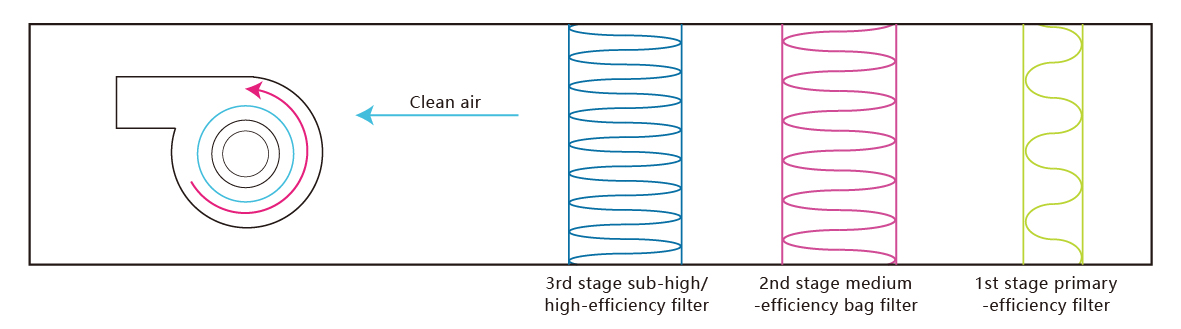
Evaluate Pre-filtration Strategy: Protect your expensive terminal filters aggressively. Ensure you specify robust primary and secondary units. Upstream MERV 8 filters capture large dust. Secondary MERV 14 units capture fine particulates. This strategy drastically extends the terminal filter lifespan.
Specify Structural Requirements: Select frame materials based on environmental rigors. Extruded anodized aluminum offers excellent lightweight durability. Stainless steel withstands aggressive cleaning agents. Match the seal type to your sterilization protocols. Vaporized Hydrogen Peroxide (VHP) cycles require highly compatible seal materials.
Selecting between an H13 and H14 grade remains a precise engineering calculation. It is never a simple "more is better" purchasing decision. You must execute a comprehensive review of your facility's unique operational constraints. Engineers must balance strict compliance mandates against long-term energy efficiency.
Ensure operational stability by matching filter resistance to blower capabilities. Ignoring these mechanical realities guarantees future system failures and compliance breaches. Always consult a specialized engineer before making final procurement decisions. Model your system pressure drops thoroughly.
Audit your current air handler capacities.
Review your upstream pre-filter conditions.
Validate your target ISO classifications mathematically.
A: Usually no. Upgrading to an H14 filter introduces significantly higher static pressure resistance. Your existing blower motor likely lacks the required capacity to push air through the denser media. This restriction reduces your total airflow volume. A lower airflow decreases your air changes per hour (ACH). It also places severe strain on the fan motor.
A: HEPA (H-class) filters capture up to 99.995% of particles at MPPS. ULPA (U-class) filters, such as U15 or higher, target 99.9995% efficiency. Facilities use ULPA filters strictly for ISO Class 4 or cleaner environments. Semiconductor fabs rely on them heavily. However, ULPA filters introduce even higher pressure drops than HEPA variants.
A: Replacement frequency depends heavily on your upstream pre-filtration quality and daily operating hours. Facilities typically replace them every three to five years. You must replace them immediately when the pressure drop reaches the manufacturer's recommended terminal limit. Routine PAO leak testing also dictates replacement if structural integrity fails.
A: Freshly installed filters rarely fail due to factory media defects. Failures almost always stem from mechanical or handling issues. Improper installation causes gasket compression failures. Incorrect seating of the gel seal allows bypass leaks. Technicians also frequently cause micro-tears in the delicate media during the physical lifting process.


