 EnglishEnglish


Views: 0 Author: Site Editor Publish Time: 2026-04-03 Origin: Site


Maintaining a contamination-free environment is one of the most critical requirements in pharmaceutical manufacturing, biotechnology laboratories, hospitals, and other cleanroom facilities. While HVAC systems play a key role in controlling airborne particles, the final filtration stage ultimately determines the cleanliness level delivered to the controlled environment.
A Gel Seal HEPA Box is specifically designed for terminal air filtration applications. Combining high-efficiency particulate filtration with advanced gel seal technology, it provides reliable clean air delivery while minimizing leakage risks. Its validation-friendly design makes it an ideal solution for pharmaceutical cleanrooms, sterile manufacturing facilities, biological laboratories, and other contamination-sensitive environments.
Today, gel seal HEPA boxes are widely used in GMP-regulated industries due to their superior sealing performance, easy maintenance, and compatibility with cleanroom qualification procedures.
A Gel Seal HEPA Box is a terminal air supply filtration unit installed at the end of a cleanroom HVAC system.
The unit houses a HEPA filter and distributes highly purified air into controlled environments while maintaining exceptional airtightness through a gel seal mechanism.
The system integrates several important functions:
• High-efficiency filtration
• Airflow distribution
• Pressure equalization
• Filter sealing
• Validation and testing support
By combining these functions into a single assembly, the gel seal HEPA box helps ensure stable cleanroom performance and regulatory compliance.
Cleanroom contamination control depends not only on filter efficiency but also on sealing performance.
Even a small air leakage path around a filter frame can allow unfiltered air to bypass the filtration system and enter the cleanroom.
Traditional gasket-sealed systems may experience aging, deformation, or installation inconsistencies over time.
Gel seal technology addresses these challenges by creating a continuous airtight barrier between the filter and the housing.
Key benefits include:
• Reduced leakage risk
• Improved cleanroom integrity
• Better contamination control
• Easier filter replacement
• Enhanced validation performance
These advantages make gel seal HEPA boxes particularly valuable in pharmaceutical manufacturing and biotechnology applications where strict contamination control is essential.
The operation of a gel seal HEPA box is based on three coordinated functions: filtration, sealing, and airflow distribution.
Conditioned air enters the HEPA box and passes through a high-efficiency filter before entering the cleanroom.
HEPA filters are capable of removing at least 99.97% of particles at 0.3 μm, effectively capturing:
• Dust particles
• Bacteria
• Aerosols
• Airborne contaminants
This filtration process ensures that only clean air is delivered into the controlled environment.
The defining feature of the system is the gel seal mechanism.
A specially formulated non-drying gel is installed around the filter frame. During installation, the knife-edge frame of the filter is pressed into the gel channel, creating a highly reliable airtight seal.
Compared with conventional gasket systems, gel seal technology offers:
• Superior sealing consistency
• Lower leakage rates
• Reduced installation errors
• Longer service life
• Easier validation
These characteristics make gel seal HEPA boxes the preferred choice for pharmaceutical and biological cleanrooms.
After filtration, air is distributed through a diffuser or louver assembly.
This design promotes uniform airflow throughout the cleanroom and helps:
• Reduce turbulence
• Eliminate dead zones
• Improve cleanliness uniformity
• Maintain process stability
Proper airflow distribution is critical for maintaining GMP-compliant cleanroom environments.
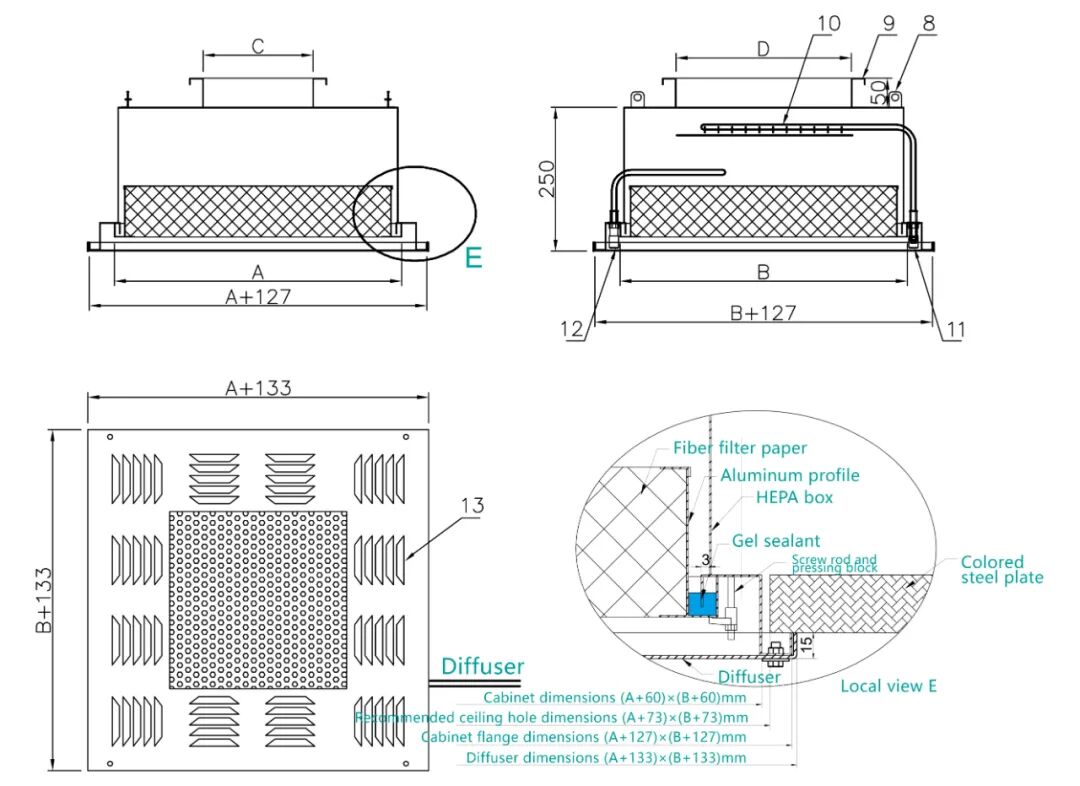
A standard gel seal HEPA box consists of several integrated components that ensure efficient filtration and reliable operation.
The HEPA filter is the core filtration element.
Common filter grades include:
• H13 HEPA
• H14 HEPA
• Customized filtration levels
The filter provides exceptional particle removal efficiency and supports various cleanroom classifications.
The gel seal system creates the airtight connection between the filter and the housing.
This design compensates for minor installation tolerances while maintaining long-term sealing reliability.
The cabinet serves as the structural support for the entire assembly.
Available materials include:
• Electrostatic powder-coated steel
• SUS304 stainless steel
• SUS316 stainless steel
Stainless steel versions are particularly suitable for pharmaceutical and biotechnology applications due to their corrosion resistance and ease of cleaning.
The PAO injection port is used during filter integrity testing.
It allows challenge aerosol to be introduced upstream of the filter for validation procedures.
This feature simplifies qualification and routine testing activities.
The DOP test port enables downstream aerosol sampling during HEPA filter integrity testing.
Combined with the PAO injection port, it supports complete cleanroom validation procedures required by GMP and international standards.
The diffuser assembly distributes filtered air evenly into the cleanroom.
Proper diffuser design improves airflow uniformity and helps maintain stable cleanliness levels throughout the protected area.
H2: Key Features of Gel Seal HEPA Boxes
Modern gel seal HEPA boxes are designed to meet the stringent requirements of pharmaceutical, biotechnology, healthcare, and electronics industries.
Key features include:
• Wide application compatibility
• Superior gel seal airtight technology
• GMP-compliant design
• Corrosion-resistant housing
• Easy filter replacement
• Validation-friendly structure
• Uniform airflow distribution
• Long service life
These features help ensure reliable cleanroom performance while simplifying maintenance and qualification procedures.
H2: Advantages of Gel Seal HEPA Boxes
H3: Superior Airtight Performance
One of the most significant advantages of gel seal technology is its exceptional sealing capability.
Unlike traditional gasket-sealed systems, the gel seal forms a continuous airtight barrier that minimizes bypass leakage and enhances contamination control.
This makes the system particularly suitable for sterile pharmaceutical production environments.
H3: Easy Filter Replacement
The filter is secured by dedicated pressing mechanisms around the cabinet.
This design allows maintenance personnel to replace filters quickly and safely while maintaining sealing integrity.
Reduced maintenance time helps improve facility productivity and minimize downtime.
H3: Excellent Corrosion Resistance
The cabinet surface can be manufactured from powder-coated steel or stainless steel materials.
These materials provide:
• Excellent corrosion resistance
• Long service life
• Easy cleaning and disinfection
• Compliance with pharmaceutical hygiene requirements
This is especially important in environments that require frequent cleaning and sterilization.
H3: Validation and Testing Convenience
The integrated PAO injection port and DOP test port simplify cleanroom qualification procedures.
These testing features allow facilities to perform:
• HEPA filter integrity testing
• Leak testing
• GMP validation
• Routine performance verification
As a result, compliance management becomes more efficient and reliable.
H3: Uniform Air Distribution
The diffuser and airflow distribution system ensure that filtered air is supplied evenly throughout the cleanroom.
Benefits include:
• Stable airflow patterns
• Reduced turbulence
• Improved cleanliness uniformity
• Enhanced process protection
Proper airflow management contributes directly to cleanroom performance and product quality.
Gel seal HEPA boxes are widely used in sterile pharmaceutical production facilities.
Typical applications include:
• Aseptic filling lines
• Sterile preparation areas
• Vaccine manufacturing facilities
• Cleanroom production environments
The airtight design helps maintain GMP compliance and reduce contamination risks.
H3: Biotechnology Laboratories
Biotechnology facilities require highly controlled environments for research and production activities.
Gel seal HEPA boxes help provide the clean air necessary for:
• Cell culture laboratories
• Biological research facilities
• Gene therapy production
• Biopharmaceutical manufacturing
Hospitals utilize HEPA filtration systems in critical healthcare environments such as:
• Operating rooms
• Isolation wards
• Pharmaceutical preparation rooms
• Sterile supply centers
Reliable filtration and sealing performance help improve infection control and patient safety.
Semiconductor production processes are extremely sensitive to airborne particles.
Gel seal HEPA boxes help maintain the ultra-clean environments required for:
• Semiconductor fabrication
• Optical component manufacturing
• Precision electronics assembly
• Microelectronics production
Choosing the right gel seal HEPA box depends on several factors.
H3: Filtration Efficiency Requirements
Select the appropriate HEPA grade according to cleanroom classification requirements.
Common options include:
• H13 HEPA
• H14 HEPA
• Customized filtration grades
Material selection should be based on the operating environment.
Recommendations include:
• Powder-coated steel for general industrial applications
• SUS304 stainless steel for pharmaceutical facilities
• SUS316 stainless steel for highly corrosive environments
The airflow capacity should match the cleanroom design and air change requirements.
Proper sizing ensures stable pressure control and effective contamination management.
Facilities operating under GMP regulations should prioritize systems equipped with:
• PAO injection ports
• DOP testing ports
• Validation-ready configurations
These features simplify qualification and compliance procedures.
What is the difference between a gel seal HEPA box and a standard HEPA terminal box?
A gel seal HEPA box uses a gel sealing system to create a more reliable airtight connection between the filter and housing, reducing leakage risks compared with traditional gasket-sealed designs.
Why is gel seal technology preferred in pharmaceutical cleanrooms?
Gel seal technology provides superior airtightness, easier validation, and improved contamination control, making it ideal for GMP-regulated environments.
Can the filter be replaced easily?
Yes. The filter is secured using a dedicated pressing system, allowing convenient replacement while maintaining sealing integrity.
What industries commonly use gel seal HEPA boxes?
Typical industries include pharmaceuticals, biotechnology, healthcare, semiconductor manufacturing, and scientific research.
Why Choose Cigeair Gel Seal HEPA Boxes?
Cigeair provides advanced terminal filtration solutions designed for pharmaceutical, biotechnology, and cleanroom applications.
Key advantages include:
• High-performance gel seal technology
• GMP-compliant design
• Corrosion-resistant construction
• Validation-ready configuration
• Easy maintenance and filter replacement
• Excellent airflow distribution performance
• Customized dimensions and specifications
• Reliable long-term operation

Looking for a reliable Gel Seal HEPA Box for your cleanroom project?
Cigeair offers customized terminal filtration solutions designed to meet GMP, ISO 14644, and pharmaceutical cleanroom requirements.
Contact our technical team today to discuss your project and receive a tailored cleanroom air filtration solution.


