 EnglishEnglish


Views: 0 Author: Site Editor Publish Time: 2026-10-13 Origin: Site


Validation engineers, QA managers, and facility directors face a constant struggle. You must establish a defensible, compliant decontamination cycle. However, you cannot over-engineer the process. The core tension often lies between standard high-level disinfection and terminal sterilization overkill. Choosing a 6-log target dictates one operational reality. Pushing for a 12-log target demands another. This crucial decision heavily influences cycle times, equipment wear, and regulatory approval.
Our goal is to clarify this complex dynamic for you. We will provide an evidence-based framework for evaluating cycle targets. You will understand current regulatory expectations for cleanrooms and isolators. Furthermore, we will show you how to optimize your Vaporized Hydrogen Peroxide (VHP) processes without damaging your assets. By the end of this guide, you can confidently match your lethality goals to your exact facility needs. You will achieve compliance while protecting your production schedule.
A 6-log reduction eliminates 99.9999% of target spores and is the global industry standard for cleanroom, isolator, and biological safety cabinet (BSC) surface decontamination.
A 12-log reduction represents the "Overkill Method," typically reserved for terminal sterilization of critical medical devices, aiming for a Sterility Assurance Level (SAL) of $10^{-6}$.
Chasing 12-log reduction in standard facility decontamination often leads to excessive cycle times, higher aeration costs, and premature material degradation with no added regulatory benefit.
Successful validation relies on accurate D-value calculations, strategic Biological Indicator (BI) placement, and matching the lethality target to the facility's specific Spaulding classification and GMP guidelines.
Understanding VHP microbial log reduction begins with baseline mathematics. We define "logarithmic reduction" simply. Each log step represents a 90% reduction in the microbial population. If you start with 1,000,000 spores, a 1-log reduction leaves 100,000. A 2-log reduction leaves 10,000. By the time you reach a 6-log reduction, only one theoretical spore remains. It is a powerful compounding effect.
Industry professionals rely on a specific biological benchmark. We use Geobacillus stearothermophilus spores. Why choose this specific organism? It exhibits exceptionally high resistance to vaporized hydrogen peroxide. If a decontamination cycle successfully kills these robust spores, it will easily eradicate common vegetative bacteria, fungi, and viruses. This organism serves as the ultimate stress test for your decontamination equipment.
Cycle development relies heavily on D-value fundamentals. The D-value is the time required to achieve a 1-log reduction under specific conditions. You calculate this value during your cycle development phase. Once you know your D-value, you multiply it by your target log reduction. If your D-value is two minutes, achieving a 6-log reduction requires at least 12 minutes of active dwell time. Understanding this multiplier is essential for building a defensible cycle.
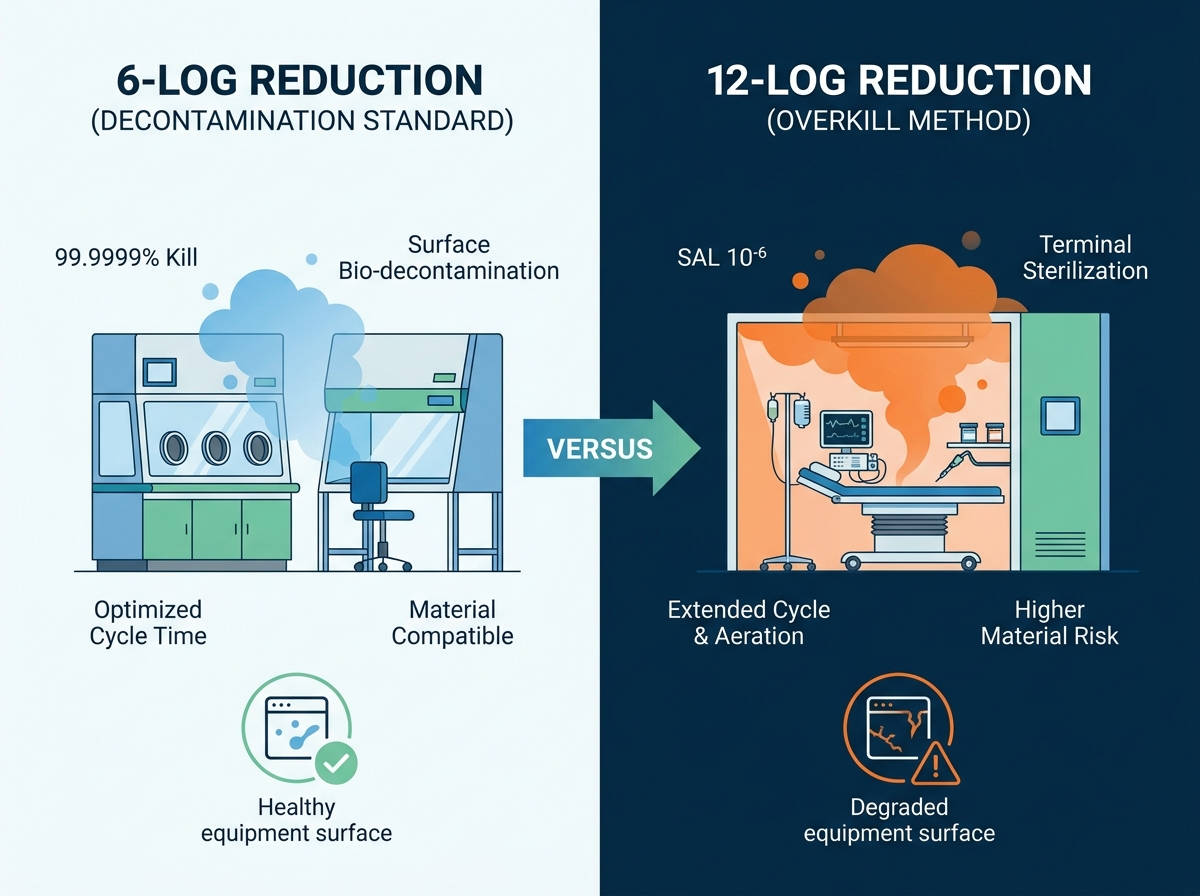
When analyzing a 6 log vs 12 log VHP reduction, you must separate surface decontamination from terminal sterilization. They serve entirely different purposes.
The 6-log profile is the undisputed standard for surface decontamination. By definition, it leaves a maximum of 1 surviving spore out of an initial population of 1,000,000. You apply this standard to enclosed spaces, isolators, pass-through chambers, and GMP cleanroom surfaces.
Regulatory bodies support this approach. Both the FDA and EMA widely accept 6-log cycles for surface bio-decontamination. EMA Annex 1 specifically recognizes this method where true terminal sterilization is physically impossible or unnecessary. It provides a highly sterile environment without subjecting a room to extreme, damaging parameters.
The 12-log profile is drastically different. It reduces the bioburden by 12 logs. Engineers model this target to achieve a Sterility Assurance Level (SAL) of 10^-6. This translates to a one in a million probability of a non-sterile unit. You apply this rigorous standard to autoclaves, gamma irradiation, and specific terminal sterilization chambers for critical tools.
You typically validate this using the Half-Cycle Approach. Instead of counting 12 logs of kill directly, you prove a 6-log reduction in a specific timeframe. Then, you simply double that exposure time. If it takes 15 minutes to kill a 10^6 biological indicator, you run the final cycle for 30 minutes. This is the essence of the Overkill method.
Comparison of Decontamination Profiles
| Feature | 6-Log Reduction | 12-Log Reduction (Overkill) |
|---|---|---|
| Primary Goal | High-level surface bio-decontamination | Terminal sterilization |
| Common Applications | Cleanrooms, isolators, pass-boxes, biosafety cabinets | Surgical implants, critical medical devices |
| Target Outcome | 1 survivor per 1,000,000 spores | SAL of 10^-6 |
| Validation Method | Direct BI verification (kill all $10^6$ spores) | Half-cycle overkill method (double the 6-log time) |
Many validation managers fall into a dangerous trap. They assume more lethality is inherently better. They mistakenly aim for a 12-log reduction in ambient cleanrooms just to feel safe. This decision carries severe consequences for your facility. You must balance VHP biological efficacy against material compatibility.
Chemical degradation risks are a primary concern. Hydrogen peroxide is a powerful oxidizer. When you double the exposure time to reach a 12-log target, you accelerate oxidation across the entire room. Epoxy floor coatings begin to blister and peel. Sensitive electronics experience microscopic corrosion on circuit boards. Elastomers, such as door seals and gaskets, become brittle and crack. Even stainless steel HVAC components can show early signs of rouging.
Operational downtime is another critical factor. A 12-log target requires significantly longer injection and dwell phases. More importantly, it requires exponentially longer aeration phases. When you push massive amounts of peroxide into a space, the gas penetrates deeper into polymers and painted surfaces. Extracting this gas to reach safe parts-per-million (PPM) levels takes hours. This extended downtime directly impacts your production yield and facility throughput.
You must balance efficacy and asset lifespan carefully. Your goal is achieving regulatory compliance. Your goal is not slowly destroying multi-million-dollar capital equipment. A properly validated 6-log cycle protects your environment and preserves your critical assets.
Choosing the correct log reduction target requires a structured approach. You cannot rely on guesswork. Follow established frameworks to guide your validation strategy.
The Spaulding classification system provides clear guidance for lethality targets. It categorizes items based on patient infection risk.
Non-critical & Semi-critical surfaces: These include floors, walls, exterior equipment panels, and standard isolators. For these areas, a 6-log reduction is entirely appropriate and legally compliant.
Critical items: These include surgical implants or tools entering sterile tissue. For these specific items, a 12-log reduction or an SAL of 10^-6 is strictly mandatory.
You must calculate the acceptable cycle time for your specific manufacturing workflow. If a 12-log overkill cycle requires four hours of aeration, can your production schedule handle it? Analyze your shift changes. Look at your batch changeover requirements. Often, a well-optimized 6-log cycle allows for faster turnaround times, preventing costly manufacturing bottlenecks.
Evaluate your VHP generators carefully. Do shortlisted units have the precision to strictly control humidity and concentration? High-quality generators hit precise lethality targets without causing condensation. Condensation occurs when vapor turns into micro-droplets. This liquid peroxide causes severe material damage and extends aeration times indefinitely. Your equipment must maintain the gas in a true vapor phase throughout the entire cycle.
Even with a clear strategy, execution presents challenges. Validation engineers encounter several common roadblocks during Performance Qualification (PQ).
Biological Indicator (BI) variations frequently disrupt testing. Not all BIs are created equal. Differing D-values across BI batches can falsely skew your validation results. A batch with a D-value of 1.5 minutes behaves differently than a batch with a 2.5-minute D-value. You must record these values carefully. Always adjust your cycle dwell time based on the specific resistance of the BI batch you are currently using.
Worst-case location mapping is essential. Do not simply place BIs in the center of the room. You must prove uniformity. Place BIs in complex corners. Put them under equipment. Stick them inside glove ports. Airflow restrictions in these difficult geometries often prevent optimal vapor penetration. Hitting a 6-log reduction in these worst-case locations proves your cycle is robust.
Aeration challenges compound with overkill methods. As mentioned earlier, longer lethal cycles leave deeper residues in plastics and polymers. This off-gassing creates a lingering hazard. It requires sophisticated aeration strategies, such as pulsed HVAC integration or active catalytic destruction. Poor aeration leads to false-positive environmental monitoring results or direct product contamination.
Finally, focus on SOP and protocol alignment. Quality Management System (QMS) documentation must be precise. Avoid generically stating "sterilization" in your cleanroom protocols. If you write "sterilization," an auditor will demand proof of a 12-log Overkill cycle. Instead, specify "6-log decontamination" or "high-level bio-decontamination." Clear terminology prevents unnecessary auditor friction and keeps your compliance records clean.
Establishing a reliable VHP cycle requires scientific precision and strategic restraint. The decision-making criteria are clear. You should choose a 6-log reduction for cleanroom and isolator surface decontamination. You must reserve a 12-log reduction for the terminal sterilization of critical medical devices. Verifiable, repeatable biological efficacy is always more critical than arbitrary, excessive exposure times.
Over-engineering your process damages equipment and throttles production. To ensure success, take immediate action. We recommend conducting a thorough risk assessment based on Spaulding classifications. Initiate a dedicated cycle development study with a qualified validation partner before finalizing your equipment specifications. A tailored approach ensures compliance, protects your facility, and optimizes your manufacturing schedule.
A: Technically, yes. They both represent a 99.9999% reduction in bioburden. However, specific documentation formats may require decimal precision. Regulatory bodies sometimes look for "6.0" to prove you met exact scientific thresholds without rounding up from a lower value.
A: Yes. VHP can achieve a 12-log reduction in controlled, dedicated sterilization chambers. However, it is rarely practical or required for ambient room or isolator surface decontamination due to long aeration times and material degradation.
A: No. Annex 1 requires a validated, sporicidal bio-decontamination process for cleanrooms and isolators. The global pharmaceutical industry universally interprets this requirement as a 6-log reduction on all accessible surfaces.
A: You use the overkill, or half-cycle, validation method. You prove total kill of a 10^6 BI in a specific timeframe. Then, you double that successful exposure time for your routine production cycles to guarantee the 12-log lethality target.


