 EnglishEnglish


Views: 0 Author: Site Editor Publish Time: 2026-11-03 Origin: Site


Secure material transfer forms the undeniable backbone of modern aseptic manufacturing and high-containment environments. A single breach during routine component transfer can instantly compromise an entire production batch. Worse, it exposes cleanroom personnel to dangerous highly potent active pharmaceutical ingredients (HPAPIs). Facility engineers and QA directors frequently encounter overlapping terminology when specifying transfer systems. This specific confusion leads to dangerous ambiguity during procurement and validation phases. Misaligned specifications often cause severe delays before critical equipment even reaches the facility floor.
This article deconstructs the precise technical distinctions between Rapid Transfer Ports (RTPs) and alpha-beta valves. We provide a clear, actionable framework for evaluating, specifying, and integrating closed transfer interfaces. You will learn exactly how to match these vital components to your operational needs. By understanding these mechanical systems deeply, you can ensure compliant, safe, and efficient material handling.
Terminology Clarity: While often used interchangeably, an "RTP" refers to the complete functional port system, whereas the "alpha beta transfer valve" refers to the specific interlocking mechanical mechanism that makes the transfer possible.
Mechanism of Action: Both systems rely on precision engineering to mate an active port (Alpha) with a passive container/bag (Beta) without exposing the internal or external environment.
Evaluation Priorities: System selection must be driven by isolator compatibility (rigid vs. flexible), material compliance (e.g., 316L stainless steel vs. single-use plastics), and ergonomic impact on operators.
Validation Reality: Mechanical reliability is only half the equation; successful implementation requires rigorous operator training, cleaning validation, and lifecycle maintenance of the seals.
Industry shorthand often blurs technical definitions. Facility engineers and procurement teams frequently wonder about the exact differences when configuring cleanroom hardware. You will often see the query RTP vs alpha beta valve appear in engineering discussions. Vendors and regulatory guidelines sometimes blend these terms loosely. This blending creates specification errors. We must define these terms accurately to build robust User Requirement Specifications (URS).
A Rapid Transfer Port (RTP) functions as the macro-level system. It encompasses the entire physical setup. This includes the port mounted on the isolator wall. It also includes the external container, whether you use a stainless steel canister or a single-use bag. Furthermore, "RTP" represents the overarching operational standard of rapid, closed-system transfer. When you specify an RTP, you ask for a complete functional method to move materials safely across a barrier.
Conversely, the alpha beta valve serves as the micro-level mechanical heart of the RTP system. It represents the actual interlocking hardware. This mechanism consists of two distinct halves. The Alpha half permanently mounts to the isolator wall. The Beta half attaches to the mobile container or transfer bag. The valve mechanism dictates how these two halves lock together securely.
Therefore, we do not face a competing scenario. You do not choose one over the other. Instead, we see a distinct "System vs. Component" relationship. Understanding this distinction proves critical for accurate vendor communication. When you communicate clearly, you avoid purchasing mismatched hardware components.
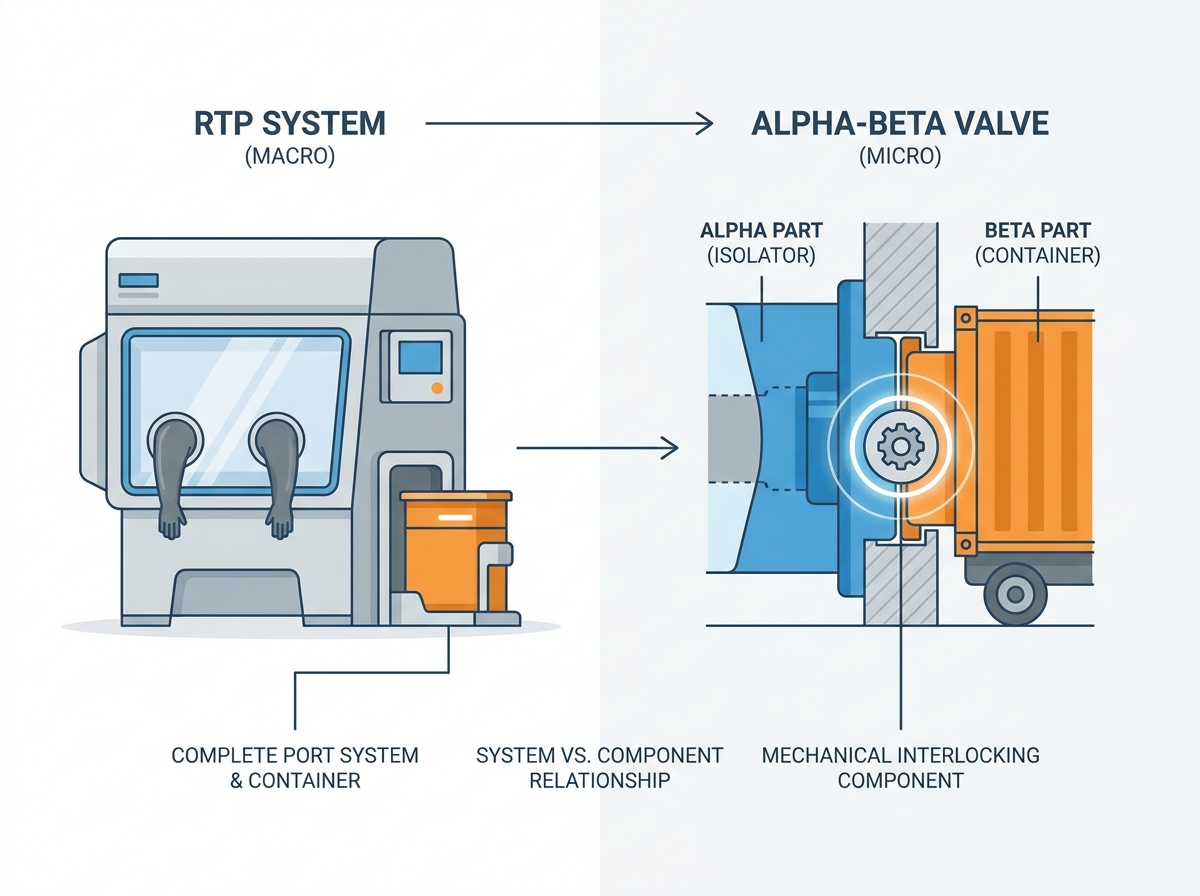
The operational sequence of this interface relies on flawless execution. Operators must follow a strict process to maintain the sterile or contained boundary. The alpha beta transfer valve executes a highly orchestrated mechanical dance.
The interlocking sequence typically unfolds in four mandatory steps:
Docking: The operator aligns the mobile Beta component with the stationary Alpha port on the isolator wall.
Rotating and Locking: The operator rotates the Beta flange (usually 60 degrees). This action locks the two halves together securely.
Opening: The operator opens the combined Alpha-Beta door from inside the isolator using integrated gloves.
Transferring: Materials pass through the open port safely. The operator then reverses the sequence to undock.
The most critical concept in this sequence is the "Ring of Concern." When the Alpha and Beta faces dock, their respective exterior seals compress tightly against one another. This compression traps any potential external contaminants between the two outer faces. When the operator opens the combined door, these trapped contaminants remain securely sandwiched between the faces. They never enter the critical isolator environment. They never expose the cleanroom upon undocking.
This efficacy relies entirely on extreme manufacturing tolerances. Precision engineering is non-negotiable. Misalignment by even a fraction of a millimeter creates devastating consequences. A poor fit leads to immediate seal failure. In rigid systems, poor tolerances cause galling. Galling occurs when stainless steel components scrape against each other, generating dangerous metallic particulates. You must evaluate these mechanical tolerances rigorously during the Factory Acceptance Test (FAT).
Integrating a rapid transfer port isolator system requires careful assessment of physical and operational constraints. Facility engineers must evaluate multiple dimensions before finalizing system architecture.
First, consider the system architecture and overall physical footprint. Isolator walls have limited real estate. The placement of the port affects operator reach and ergonomics. You must select standard port sizes based on your specific payload requirements. Selecting the wrong size severely limits operational flexibility.
Common Port Sizes and Payloads
| Port Size Diameter | Typical Payload Application | Common Integration Scenario |
|---|---|---|
| 105mm | Environmental monitoring plates, small vials. | Compact aseptic processing isolators. |
| 190mm | Standard tools, API powder transfer bags. | General-purpose high-containment units. |
| 270mm | Stoppers, caps, large component bowls. | High-volume filling lines. |
| 350mm | Large equipment parts, pump heads. | Complex maintenance and retrofit operations. |
Material compatibility forms the next critical evaluation pillar. The Alpha port typically utilizes 316L stainless steel, PEEK, or advanced engineered plastics. These materials must withstand aggressive biodecontamination cycles. Vaporized hydrogen peroxide (VHP) degrades inferior plastics quickly. Ensure your selected materials carry proven VHP resistance certificates.
For the Beta components, you face a strategic choice. Rigid stainless steel canisters offer immense durability. They are reusable but require intensive autoclaving and cleaning validation. Conversely, single-use Beta bags eliminate complex cleaning validation entirely. However, they introduce rigid supply chain dependencies. You must assess your facility's ability to manage single-use inventory effectively.
Finally, evaluate ergonomics and usability. Operators perform dozens of transfers daily. Assess the physical force required to dock and rotate the beta component. High-torque systems lead to rapid operator fatigue. Fatigued operators make mistakes. Improper docking increases the risk of severe containment breaches. Choose systems featuring smooth, low-friction locking mechanisms.
You must frame your system selection around what exactly needs protecting. The direction of protection changes the fundamental design requirements.
Aseptic and sterile manufacturing focuses entirely on protecting the product. The goal is keeping the inside of the isolator sterile. These systems operate under positive pressure. If a minor leak occurs, clean air pushes outward, preventing external contaminants from entering the critical zone. You prioritize sterility assurance and particulate control.
Toxic and HPAPI handling flips this paradigm. Here, the focus shifts to protecting the operator and the surrounding environment. The goal is keeping hazardous materials strictly inside the isolator. These systems operate under negative pressure. If a leak occurs, air pulls inward, preventing toxic powders from escaping into the cleanroom. You prioritize absolute containment and robust seal integrity.
Aseptic vs. HPAPI Focus Areas
Aseptic Processing: Positive pressure, product protection, VHP compatibility, particulate minimization.
HPAPI Containment: Negative pressure, operator protection, bidirectional seal design, safe waste removal.
Seal design variations cater to these different needs. Some designs are optimized specifically for bi-directional containment. Others feature specialized liquid transfer capabilities using integrated aseptic connectors. For toxic applications, continuous liner systems provide safe waste removal without breaking containment.
You must always apply strict compliance lenses. Industry standards dictate the performance of these interfaces. ISO 14644 governs cleanroom particulate classifications. EU GMP Annex 1 imposes rigorous requirements for barrier technologies. Annex 1 specifically mandates robust contamination control strategies. Your chosen transfer system must provide documented evidence of leak tightness and sterility maintenance to satisfy these regulatory bodies.
Mechanical reliability represents only half the operational equation. The implementation reality brings significant engineering and human challenges. Designing a system into a new build allows for optimal placement. Retrofitting a new port into an existing cleanroom setup presents severe engineering hurdles.
During retrofits, you must evaluate wall thickness and structural integrity. Older isolator panels may require reinforcement to handle the torque generated during docking. Space constraints often force compromised ergonomic placements. You must conduct careful 3D modeling before cutting into an existing barrier.
The human element remains the most unpredictable variable. The most advanced interlocking valve can fail due to simple operator error. Cross-threading, incomplete rotation, or forcing a misaligned container will breach the system. You must develop bulletproof Standard Operating Procedures (SOPs). Emphasize tactile training. Operators need physical mock-ups to practice proper docking alignment until the motion becomes muscle memory.
Lifecycle management and rigorous maintenance keep the facility compliant. Seal degradation happens continuously. Lip seals and O-rings face repeated mechanical stress and harsh chemical exposure. They require strict, documented preventative maintenance schedules. Never wait for a seal to fail visibly. Replace them based on validated cycle counts.
Furthermore, manage the logistical burdens of single-use Beta bags. These bags require careful inventory management. More importantly, operators must perform visual or automated integrity testing prior to use. A pinhole leak in a single-use bag compromises the entire transfer process instantly. Factor these operational realities into your daily workflows.
Specifying the right closed transfer interface requires moving far past simple acronyms. You must focus intently on the mechanical reliability of the interlocking valve. You need to verify the material compatibility of the physical port against your decontamination protocols. Most importantly, you must acknowledge the ergonomic reality for your daily operators.
Before finalizing your User Requirement Specifications, take proactive steps. Request detailed mechanical drawings from your vendors. Demand comprehensive material certificates for all contact surfaces. Insist on physical docking demonstrations using exact mock-ups. Testing the physical torque and alignment process firsthand prevents disastrous implementation failures. Prioritize precision, usability, and rigorous compliance to secure your critical manufacturing boundaries.
A: Generally no. Different manufacturers use proprietary tolerances and distinct locking geometries. Mixing components creates severe liability issues and voids performance warranties. While industry standardization efforts exist, relying on a single vendor for both halves ensures proper seal compression and guarantees barrier integrity during validation.
A: Replacement frequency varies significantly by VHP exposure and mechanical cycle count. There is no universal timeframe. You must define replacement schedules through specific validation studies and strict adherence to manufacturer guidelines. Implementing a preventative maintenance plan based on documented cycle limits prevents unexpected containment failures.
A: Yes, they are compliant. However, the vendor must supply robust validation data. You need documented proof regarding minimal particulate shedding, sterility assurance levels, and comprehensive leak testing methodologies. Your facility must also implement strict pre-use inspection protocols to satisfy Annex 1 contamination control strategy requirements.


