 EnglishEnglish


Views: 0 Author: Site Editor Publish Time: 2026-06-13 Origin: Site


Upgrading or equipping a modern lab facility requires strict adherence to detailed biological risk assessments. Choosing the wrong primary containment equipment immediately invites regulatory failure. It also risks severe cross-contamination and presents unacceptable personnel hazards. Facility planners and buyers often struggle to navigate the complex airflow requirements separating various Class II subtypes, such as A2, B1, B2, and C1. Many underestimate the massive facility HVAC infrastructure needed to safely integrate these systems into a building.
We offer an evidence-based breakdown of Class II selection criteria and critical baseline certification requirements. You will learn how to evaluate specific airflow mechanics, navigate facility infrastructure dependencies, and guarantee regulatory compliance. This ensures you procure the correct unit for your precise biological and chemical hazard profile.
Class II biosafety cabinets are the industry standard for BSL-2 and BSL-3 labs, providing personnel, product, and environmental protection.
The choice between Type A2 and Type B2 hinges entirely on the volume of volatile toxic chemicals and radionuclides used in your workflow.
Type B2 cabinets require extensive facility infrastructure (hard-ducted exhaust), significantly increasing HVAC loads and operational costs.
Annual certification to standards like NSF/ANSI 49 is a regulatory necessity, requiring rigorous HEPA leak testing and airflow velocity profiling.
A "clean bench" is not a biosafety cabinet; proper terminology and equipment matching are critical for safety compliance.
Establishing baseline safety starts by understanding equipment tiers. We must contrast the Class II design against simpler or more extreme alternatives. A Class I laboratory containment cabinet protects the user but offers zero product protection. Unfiltered room air passes directly over the work surface. Conversely, Class III systems are maximum-containment glove boxes. They act as fully sealed enclosures for the deadliest pathogens. Most modern research facilities do not require this extreme level of isolation.
The Class II design represents the perfect operational balance. It serves as the daily workhorse for global diagnostic and research teams. A standard microbiological safety cabinet achieves three distinct pillars of protection simultaneously. These include:
Personnel Protection: An inward flow of air at the front opening prevents aerosols from escaping toward the operator.
Product Protection: HEPA-filtered vertical downflow air bathes the work surface. This prevents cross-contamination between delicate samples.
Environmental Protection: All exhausted air passes through a secondary HEPA filter before leaving the unit. This stops hazardous agents from entering the room.
Industry regulators mandate Class II units as the primary baseline for Biosafety Level (BSL) 2 and 3 environments. Leading institutions align their internal policies directly against WHO biosafety guidelines. Handling infectious agents safely requires absolute trust in these three protection pillars.
Selecting a class ii biosafety cabinet requires matching precise airflow mechanics to your chemical risk profile. The primary decision usually comes down to Type A2 versus Type B2. Both provide identical biological safety. However, they handle chemical vapors very differently.
The Type A2 model serves as the versatile standard across most industries. It recirculates approximately 70% of its internal air through a supply HEPA filter. It exhausts the remaining 30% back into the room or out through a canopy connection. We recommend the A2 for microbiological research involving minute, non-volatile chemical quantities. This design minimizes facility HVAC demands. It consumes less energy and installs easily.
The Type B2 represents the 100% exhaust model. It recirculates zero air. Every cubic foot of air entering the unit exhausts directly to the outside through a dedicated hard duct. You must choose a B2 when your workflow involves significant volumes of volatile toxic chemicals or radionuclides. HEPA filters catch particles, but they cannot catch chemical gases. The B2 purges these dangerous gases entirely. However, B2 units demand immense energy. They require dedicated roof exhaust blowers. They also rely on complex, sensitive alarm calibrations.
Some labs require hybrid solutions. Type B1 units offer partial exhaust for specific zones. They push contaminated air from the rear work zone outside while recirculating clean air in the front. Type C1 cabinets provide convertible operational modes. They switch between A2 and B2 functionality, giving dynamic laboratories superior flexibility.
| Cabinet Type | Recirculated Air | Exhausted Air | Volatile Chemical Suitability |
|---|---|---|---|
| Type A2 | 70% | 30% (Room or Canopy) | Minute quantities only |
| Type B1 | 30% | 70% (Hard Ducted) | Moderate quantities in rear zone |
| Type B2 | 0% | 100% (Hard Ducted) | Significant quantities |
| Type C1 | Variable | Variable | Adaptable based on mode |
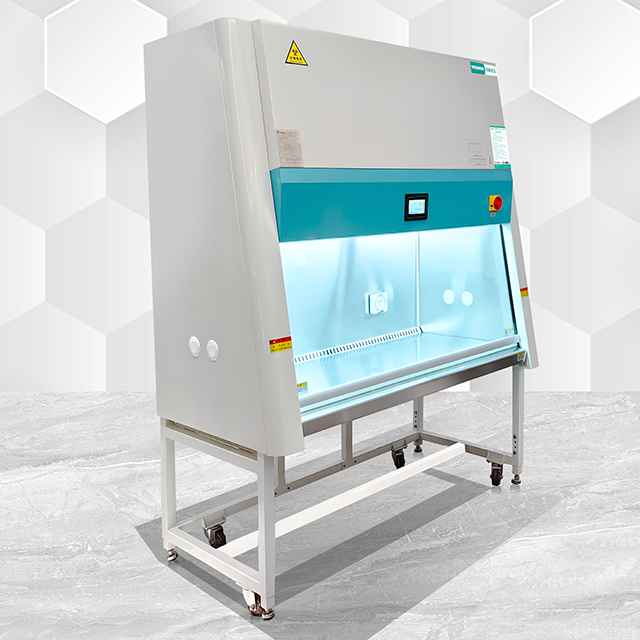
Buyers routinely ignore the strict facility requirements needed to support sophisticated containment equipment. Installing a hard-ducted Type B2 cabinet creates profound HVAC dependencies. Since a B2 model exhausts 100% of its air, it pulls hundreds of cubic feet per minute from your laboratory. Your building's HVAC system must supply an equal volume of conditioned make-up air. If the building cannot deliver this volume, the room becomes dangerously negatively pressured. Doors will slam shut. Temperature controls will fail completely.
Furthermore, hard-ducted systems introduce complex safety vulnerabilities regarding airflow balance. If the building's roof exhaust fan fails, the internal cabinet blower cannot keep pushing air into a dead duct. Doing so causes immediate blow-back. Contaminated air and dangerous chemicals would flood directly into the operator's face.
To prevent this hazard, facilities must install precise exhaust alarms and interlocks. The implementation reality of these safety systems is highly technical. A pressure switch monitors the static duct pressure continuously. If duct pressure drops, the interlock system triggers instantly. It shuts down the cabinet's internal supply blower automatically. It triggers visual and audible alarms. Operators must immediately cap their hazardous chemicals and step away. Calibrating these interlocks requires skilled engineering. Minor weather changes or building pressure fluctuations can cause nuisance alarms if set improperly. You must ensure your facility engineers understand these rigorous interlock dependencies before approving a B2 installation.
Owning a containment unit mandates strict ongoing quality control. Regulatory frameworks govern how we test and validate these enclosures. North American facilities adhere strictly to NSF/ANSI 49 standards. European facilities follow the EN 12469 standard. These protocols dictate identical end goals: uncompromised biological containment.
Field certification is not optional. It verifies your equipment performs precisely to factory specifications in its final installed location. A simple visual inspection is never sufficient. Certified technicians perform quantitative tests using calibrated instruments.
| Test Name | Purpose | Methodology |
|---|---|---|
| Inflow Velocity Test | Verifies personnel protection. | Measures the air speed entering the front access opening using a direct inflow measurement instrument or anemometer. |
| Downflow Velocity Test | Verifies product protection. | Measures vertical air speed inside the work zone to ensure uniform laminar flow without turbulence. |
| HEPA Filter Leak Test | Verifies filter and seal integrity. | Introduces a PAO aerosol upstream. Scans the downstream filter face with a photometer to detect leaks over 0.01%. |
| Airflow Smoke Pattern Test | Verifies directional flow dynamics. | Uses visible smoke to confirm air moves smoothly inward and downward without creating dead spots or escaping the sash. |
The implementation reality requires strict scheduling. You must certify cabinets upon initial installation before any biological work begins. You must recertify them after any relocation, even moving them across the same room. Furthermore, regulators require comprehensive recertification annually. Some high-risk BSL-3 facilities demand biannual testing. Budgeting for external third-party certifiers remains a mandatory operational requirement. Neglecting this maintenance invalidates your safety protocols immediately.
Commercial terminology frequently confuses new laboratory planners. Many people mistakenly ask for a bsc clean bench. This term is inherently contradictory. A clean bench and a biosafety cabinet serve entirely different scientific purposes. You must separate these concepts to maintain a safe working environment.
The primary difference lies in the direction of the airflow. A clean bench relies on horizontal or vertical laminar flow. It passes air through a HEPA filter and blows it directly across the work surface toward the operator. This design keeps dust and contaminants away from your sensitive samples. It provides excellent product protection. However, it provides absolutely zero personnel protection. Any particles generated on the work surface blow straight into the user's breathing zone.
Proper risk mitigation relies on matching the tool to the hazard. You must never use a clean bench for potentially infectious materials. You must never use it for hazardous chemicals or sensitizing agents. If your protocol involves human pathogens, cell lines, or unpredictable biological agents, you must use proper containment equipment. Misunderstanding this simple airflow distinction leads to severe laboratory acquired infections.
Buying the correct containment equipment requires a structured, logical approach. Rushing into a purchase based on upfront pricing usually results in dangerous mismatches. Follow these distinct steps to guarantee a compliant procurement process.
Step 1: Consult the Risk Assessment. Review your laboratory’s formal biological and chemical risk assessment. Sit down with your Institutional Biosafety Committee (IBC) or Environmental Health and Safety (EHS) officer. Document the exact pathogens you will handle. Catalog the specific volumes of volatile chemicals involved in your standard operating procedures.
Step 2: Audit Facility Capabilities. Bring your facilities engineering team into the conversation early. Confirm whether your current HVAC system can support a canopy connection for an A2 unit. If your risk assessment demands a B2, verify your building can handle dedicated hard ducting and supply the necessary make-up air. Evaluate roof space for external exhaust blowers.
Step 3: Evaluate Manufacturer Support. Shortlist vendors based on technical specifications and local service availability. Assess the ease of their internal decontamination processes. Look for ergonomic designs. Angled sashes, adjustable stands, and padded armrests prevent operator fatigue during long pipetting sessions. Ensure local technicians carry the correct parts for annual maintenance.
Selecting the ideal containment equipment requires carefully balancing your specific workflow hazards against rigid facility infrastructure limits. Every decision must prioritize operator safety and environmental protection without overwhelming your building's HVAC capabilities. Keep these final action steps in mind as you move forward:
Finalize your chemical and biological risk profiles before requesting any vendor quotes.
Remember that over-specifying a Type B2 when a Type A2 suffices results in wasted infrastructure effort and unnecessary complexity.
Never compromise safety by under-specifying equipment; always match the cabinet class to your highest potential BSL hazard.
Partner closely with your EHS team and facilities engineers to ensure successful integration and mandatory alarm interlock setup.
Schedule your initial NSF/ANSI 49 field certification immediately upon installation to validate full regulatory compliance.
A: No, unless the chemicals are in extremely minute quantities and the cabinet connects to a building exhaust system via a canopy (thimble) connection. An A2 recirculates 70% of its internal air. It will trap and concentrate chemical vapors inside the work zone, creating a significant hazard for the operator.
A: Industry standards typically require field certification annually. You must also certify the unit upon initial installation, after any physical relocation within the lab, or after major maintenance events like HEPA filter replacement or motor repairs.
A: A canopy connection leaves a physical air gap for Type A2 cabinets. This gap prevents building exhaust fluctuations from affecting the cabinet's internal downward airflow. A hard-duct connection is fully sealed and physically pulls air from the cabinet. It is completely mandatory for Type B2 operations.
A: No. The internal plenum design, airflow ratios, and motor configurations of B2 and A2 cabinets are fundamentally different. You cannot safely retrofit them. However, newer Type C1 cabinets do offer built-in operational flexibility, allowing facilities to switch between modes.


